
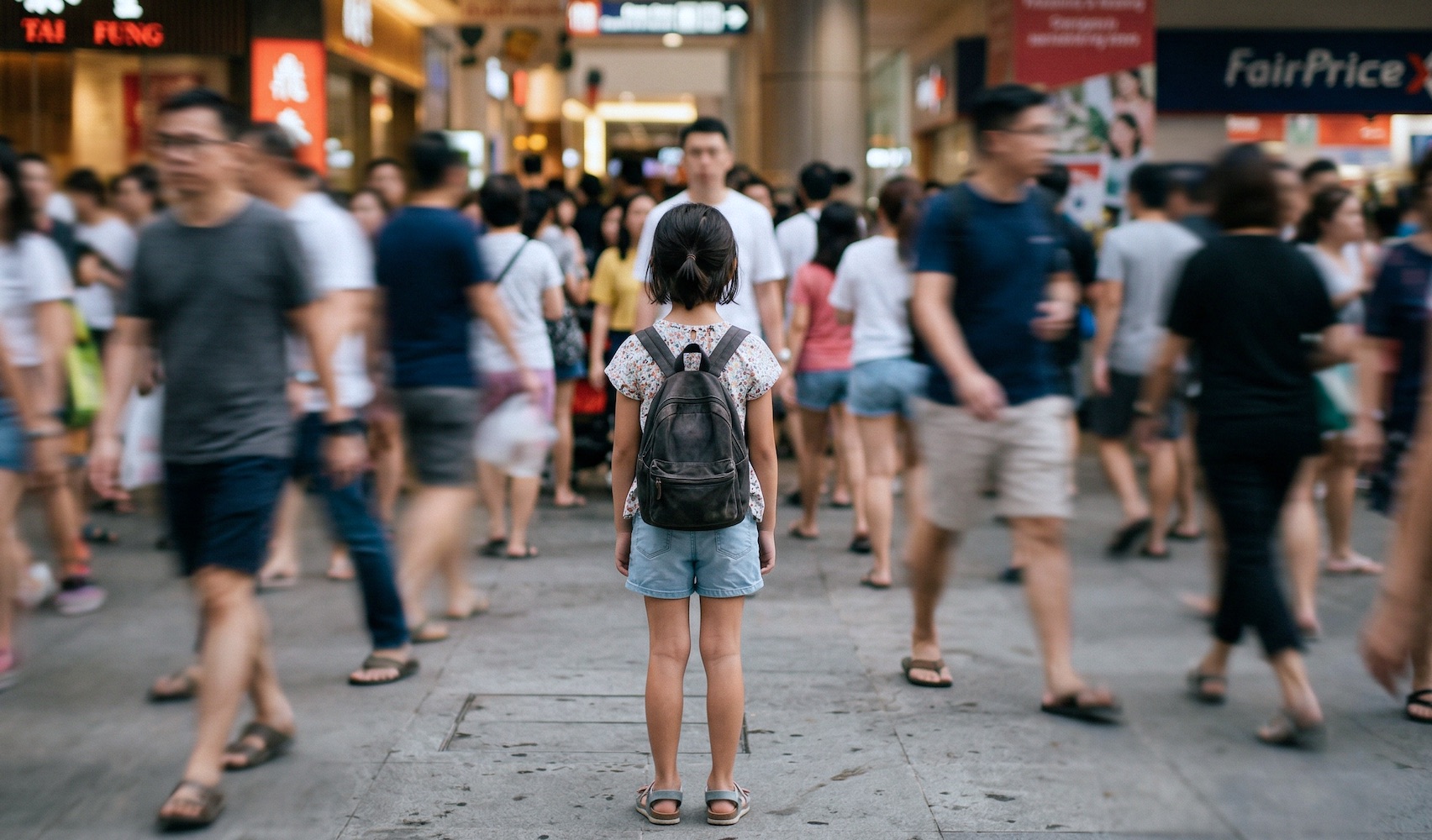
While we were waiting for the lift at Nex in Serangoon, a woman I'd never met decided to tell my seven-year-old daughter that her laugh was "too piercing" for a public space. My daughter froze. Her eyes darted to mine, searching for the rulebook on how to handle a grown-up being unkind for no reason. I felt that familiar heat in my chest, the urge to snap back, but then I saw her confusion and realised this wasn't about the noise at all. It's a heavy weight to carry when someone attacks your child's joy.
What makes a total stranger feel entitled to bark at a child on a public pavement?
The smell of old coffee. The sound of high heels clicking. The sudden, sharp "tsk" that cuts through the hum of the crowd. Often, these outbursts from strangers come from a place of deep-seated stress or an outdated view of "communal discipline." In some parts of Singapore, there is still this lingering idea that it takes a village to raise a child, but some people use that as an excuse to be plain rude. They might be having a terrible day, or perhaps they grew up in a house where children were meant to be invisible and silent like furniture.
It's rarely about what your child actually did. I've noticed that most "unreasonable" adults are actually just projecting their own lack of control onto the easiest target they can find. A child is small. A child is soft. A child doesn't usually fight back with a clever retort. When a stranger chooses to scold a little one for being "messy" while eating kaya toast, they are often just venting their own frustration with a world they can no longer keep tidy. If you ask me, that is their mess to clean up, not yours.
Could these awkward run-ins actually be the secret to building a stronger kid?
The feeling of being watched. We often want to wrap our children in bubble wrap to keep them away from the world's sharp edges. But what if we looked at these grumpy uncles and aunties as "social gym equipment"? They provide a low-stakes way for our kids to learn that not everyone in the world is going to be kind, and that is okay. It doesn't mean the child has done something wrong; it just means the world is full of different temperaments.
By reframing these moments, we stop being victims of a stranger's bad mood. Instead of a traumatic event, it becomes a living lesson in boundaries. You aren't just protecting your child from a one-off comment; you are showing them how to stay steady when the wind blows hard. It turns a moment of shame into a moment of shared strength between you and your little one. Think social resilience—the idea that small "stings" can help build a thicker skin for the big stuff later in life.

What are the specific tools a child can use when the world gets a bit too loud?
1. The Silent Pivot
Teach your child that they don't owe a stranger their attention or their words. If someone is being unreasonable, the best response is often to simply turn their body toward you. This physical "pivot" signals to their brain that they are safe with you and that the stranger's noise is just background static. It is a quiet way of saying, "I don't accept this," without escalating the drama.
2. The Polite Wall
Give them a script that ends the conversation immediately. A simple, "I am with my mummy/daddy, thank you," is enough. It acknowledges the person exists but firmly shuts the door on any further "advice." Practice this at home so it feels natural. The goal isn't to be rude back, but to be as uninteresting as a brick wall so the stranger moves on to find a more reactive target.
3. The Eye-Contact Check
When a stranger starts a "lecture," many children look down at their shoes in shame. Tell your child to look at you instead. By locking eyes with a trusted parent, they "ground" themselves in your reality rather than the stranger's anger. It breaks the spell of the scolding. It keeps them from soaking up the shame that doesn't belong to them.
4. The Physical Buffer
This is your job. Step in. You don't need to scream or make a scene, but you should physically place yourself between the adult and your child. This "buffer" shows your child that you are their shield. The wet umbrellas dripping on the floor, the smell of toasted bread from the nearby stall, the stranger's sharp voice, and the way your son's grip tightens on your hand can make the whole world feel suddenly very tight, but your presence makes it manageable. Do that.
5. The Post-Event Chat
The real work happens after the stranger walks away. Ask your child, "That person seemed very grumpy, didn't they? Why do you think they were so sad today?" This moves the focus from "I am a bad kid" to "That person is having a hard time." It keeps their heart soft while their mind stays sharp. It's a way to process the "ick" so it doesn't stick to their ribs.
What are we actually teaching them when we let a stranger's bad mood ruin the day?
We cannot control the "unreasonable" people at the wet market or on the MRT. We can only control the shelter we provide. Our children are watching us to see if a stranger's opinion carries more weight than our own. If we get flustered and start scolding our child just to appease a random person, we're teaching them that their safety is conditional. We're telling them that a stranger's comfort is more important than their own peace. That's a lesson they'll carry for a long time.
Next time a stranger decides to give your child an unearned piece of their mind, take a breath. Look at your child's face. Are you reacting because the stranger is right, or because you're embarrassed by the noise they're making? At the next opportunity, ask yourself: Am I being a bridge for that stranger's anger to reach my child, or am I being the wall that stops it cold?