
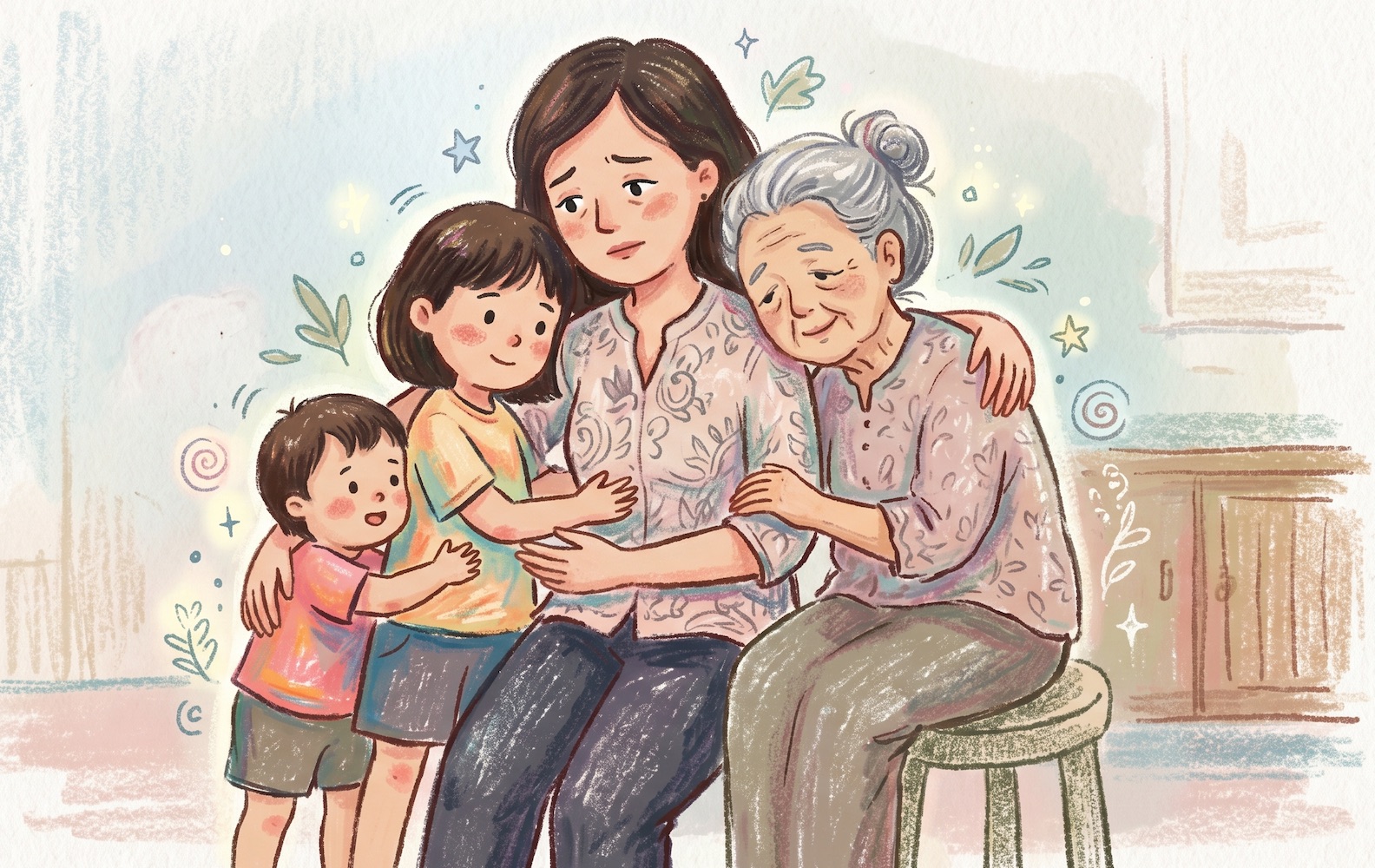
I'm at my breaking point. Between my toddler's meltdowns and my father-in-law's worsening dementia, I feel like I'm disappearing. My husband works late to cover the medical bills, so the bulk of the "nursing" falls on me. I love him, but I've started to resent his parents deeply. This isn't the life I imagined when we got married. We haven't had a proper date in a year, and every conversation is about medication or diapers—either the kid's or his dad's. I didn't sign up to be a full-time nurse for his parents while raising ours. Is my marriage even going to survive this weight?
The invisible cost of the "Sandwich" generation
I want to start by saying something you might need to hear: You are not a "bad" person, a "bad" daughter-in-law, or a "bad" wife for feeling this way. What you are describing is a very real, very heavy form of caregiver burnout that is reaching a flashpoint. In Singapore, we often talk about filial piety as an absolute, but we rarely talk about the domestic erosion it causes when one partner bears the brunt. You feel like a nurse because, right now, your home has become a ward rather than a sanctuary.
To move forward, the perspective needs to shift from "survival" to "sustainability." You cannot pour from an empty cup, and you certainly cannot sustain a marriage on resentment. You and your husband need to stop acting as individual fire-fighters and start acting as a management team. This isn't just a "family phase"—it is a structural crisis in your household that requires a structural solution, not just more "patience."
Actionable steps to reclaim your marriage and sanity
1. Conduct a radical "care audit"
Sit down with your husband and list every single task you do in a week, from changing diapers to managing medication and hospital appointments. Visualising the sheer volume of work helps move the conversation from "I'm tired" to "This workload is mathematically impossible for one person." This is the basis for redistributing chores or hiring external help.
2. Utilise the "Home Caregiving Grant" and outsourcing
In Singapore, the Agency for Integrated Care (AIC) offers various grants. Use these funds specifically to outsource the most draining tasks. Whether it's a part-time caregiver for a few hours a week or a specialised cleaning service, removing even 10% of the physical labour can provide the mental breathing room you need to remember you are a wife, not just a staff member.
3. Schedule "The State of the Union" meetings
Separate your "caregiver" talk from your "marriage" talk. Set a 30-minute meeting once a week to discuss logistics (medical appointments, kids' school). Outside of that window, try to keep the "nurse" talk to a minimum. This protects your remaining time together from being entirely consumed by the very things causing the resentment.
4. Engage the "Extended Family Council"
If your husband has siblings, it is time for a difficult, transparent conversation. If they cannot provide physical time, they must provide financial support to hire help. Being the "stay-at-home" or "more flexible" spouse does not make you the default sole caregiver for in-laws. Silence here only breeds deeper bitterness.
5. Prioritise "Micro-Respite" sessions
Look into overnight respite care options at nursing homes or senior care centres. Even a 3-day weekend where your father-in-law is in professional care can allow you and your husband to reconnect. It is not "abandoning" him; it is "preserving" the family unit that supports him.
The "Sandwich" survival checklist: What NOT to do
-
Don't suffer in martyr-like silenceThinking that "enduring" makes you a better spouse is a myth; it only ensures that when you finally break, the damage to your marriage will be permanent.
-
Don't weaponise the caregiving in argumentsAvoid saying "Your parents are ruining us." Instead, focus on the situation: "The current caregiving arrangement is hurting our relationship." Attack the problem, not the parents or the spouse.
-
Don't cancel your own health appointmentsThe moment you stop caring for your own physical and mental health to "save time" for others, you accelerate the collapse of the entire household.
-
Don't compare your life to social mediaSeeing "perfect" families on Instagram who seem to balance it all will only make you feel isolated. Their reality likely doesn't involve the "Sandwich" pressures you are facing.
-
Don't wait for a medical crisis to ask for helpIf you wait until someone ends up in the A&E from exhaustion or a fall, your choices will be limited and forced. Plan the support system while you still have a clear head.
A reality check for the road ahead
Here is the hard truth: Your children will grow up and eventually leave the nest, and your parents will eventually pass on. But your spouse is the person who is supposed to be standing there with you when the dust settles. If you sacrifice the marriage on the altar of caregiving, you will find yourself in a very quiet, very lonely house a decade from now. It is okay to set boundaries. It is okay to say, "I cannot do this alone." Choosing your marriage isn't a betrayal of your parents; it's a commitment to the future you're building.
Support resources for Singaporean caregivers
-
The primary portal for eldercare grants, home care services, and caregiver support in Singapore.
-
Offers specialised training and emotional support specifically for those caring for loved ones with mental health issues or dementia.
-
Local hubs for social support, counselling, and financial assistance for families under stress.
-
Provides home-based services and caregiver aiders to help lighten the physical load of nursing.
-
Offers family counselling to help couples navigate the relational strain of the sandwich generation.