Pandora's Box: The Weight of Consequences

A mysterious gift, a nagging whisper of curiosity, and a choice that changed the world forever. Pandora's Box is a visceral exploration of impulse and the "point of no return." It challenges them to recognise that while curiosity is a gift, the power to unleash consequences is a heavy responsibility.

AccountabilitySelf-RegulationResilience

Pandora's Box

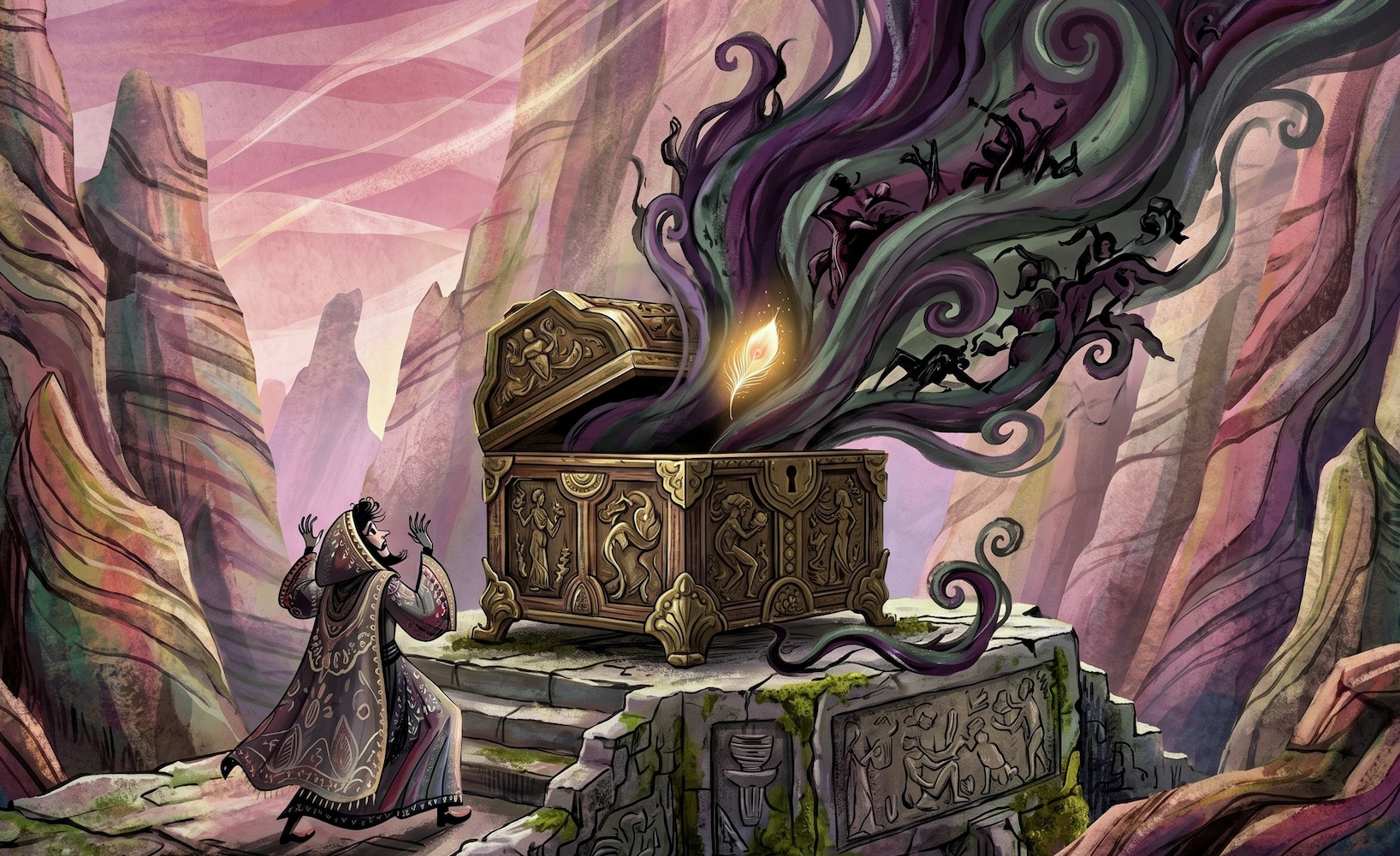
Pandora was created to be the perfect human—gifted with beauty, charm, and a sharp, inquisitive mind. When she was sent to Earth to marry Epimetheus, Zeus gave her a parting gift: a beautifully carved jar, sealed tight and heavy with a mysterious weight. "It is a wedding gift," Zeus whispered, his eyes gleaming with a hidden motive. "But you must never, under any circumstances, open it."

For months, the jar sat in the corner of her home like a silent challenge. Pandora wasn't a "bad" person; she was a brilliant one. Her mind was built to solve puzzles and uncover secrets. Every day, the jar seemed to hum with a quiet energy. "What could be so dangerous that it must stay hidden?" she wondered. "Perhaps it is a treasure. Perhaps Zeus is testing my worthiness to see it." The curiosity wasn't a flaw—it was a fire that eventually grew too hot to contain.

One afternoon, the silence of the house became unbearable. Pandora placed her hand on the lid. She told herself she would only take a tiny peek, just a sliver of light to see what lay inside. But the moment the seal broke, the lid flew back with a violent force. A dark, chaotic swarm erupted—bitterness, sickness, envy, and every form of suffering imaginable. They shrieked as they flew out the windows and doors, spreading across the world like a shadow. Pandora tried to slam the lid back down, but it was too late. The "box" was empty; the peace of the world had been traded for a moment of "knowing."

Pandora fell to the floor, weeping at the chaos she had unleashed. But then, a tiny, golden glow flickered from the very bottom of the jar. It was "Elpis"—Hope. Despite all the darkness Zeus had hidden in the jar, he had also included the one thing that could make the darkness bearable. Pandora realised then that while she could never take back her mistake, she could choose to hold onto the light that remained. The world was changed, but because of Hope, it wasn't defeated.

Share This

Bringing the Story Home

Use these notes to translate the story into a meaningful conversations.

Lesson behind the Tale

Impulse is a spark; consequence is the fire. Curiosity is a magnificent tool, but without the discipline to wait and the wisdom to weigh the cost, it can open doors that can never be shut. Once a word is spoken or an action is taken, it belongs to the world, not to you. Responsibility means thinking about the "aftermath" before you break the seal.

Relating to Our World

For a 13-15 year old in Singapore, "Pandora's Box" is in their pocket. Every time they open an app, they are dealing with a platform built to trigger their curiosity and bypass their impulse control. Whether it's a "leak" of a private photo, a sharp comment in a group chat, or opening a link they know they shouldn't, the digital world is full of "lids" that are very easy to break and impossible to put back.

We can use this myth to discuss Digital Permanence. We want our teens to understand that once the "swarm" (the data/the rumour) leaves the jar, it's gone. However, we also want to talk about the "Hope" at the bottom. If they do make a mistake and unleash a mess, their life isn't over. Accountability and Hope work together—you admit the mistake, you deal with the consequences, and you use that golden flicker to build something better next time.

Opening the Dialogue

"Zeus knew Pandora was curious when he gave her the jar. Do you think he set her up to fail, or was he giving her a chance to prove she could control her impulses?"

  • If they say 'It was a trap' "In many ways, it was. Much like how social media apps are designed to be addictive. If you know a situation is designed to make you fail, does that make you want to be more careful, or do you feel like it's not your fault if you slip up?"
  • If they say 'It was a test' "Tests are hard because they require you to say 'no' to yourself. As you get more freedom, you'll face more 'jars' that I won't be there to guard. How do you tell the difference between 'good' curiosity and 'destructive' impulse?"

"Hope was the only thing left in the box. Why do you think Hope was in the same jar as all those terrible things? Is Hope a gift, or is it just another way to make us keep struggling?"

  • If they say 'It's a gift' "It's the ultimate survival tool. It's what lets a person say, 'I messed up today, but I can make it better tomorrow.' When you've had a 'Pandora moment'—a day where everything went wrong—what is the 'Hope' you hold onto?"
  • If they say 'It's a trick' "That's a deep perspective. Some philosophers say Hope keeps us in the game even when we're losing. But without it, we stop trying altogether. If you could go back, would you rather Hope stayed in the jar, or are you glad it got out?"

Putting it into Practice

Impulse thrives on speed. Your challenge this week is to create an artificial "seal" on your own digital jars. Before you hit 'Send' on a comment, before you 'Share' a rumour, and before you 'Open' a notification that feels like a distraction, count to seven slowly. In those seven seconds, ask yourself: "Once this is out of the jar, will I be glad it's gone, or will I be wishing I had the lid back?" Observe how many 'swarms' you prevent just by giving your brain a moment to catch up with your thumb.

Build Character, One Story at a Time

Nurturing values like integrity and courage doesn't happen overnight. Explore our full library of stories designed to help parents navigate every milestone.

Browse More Stories About Life

Recommend for You