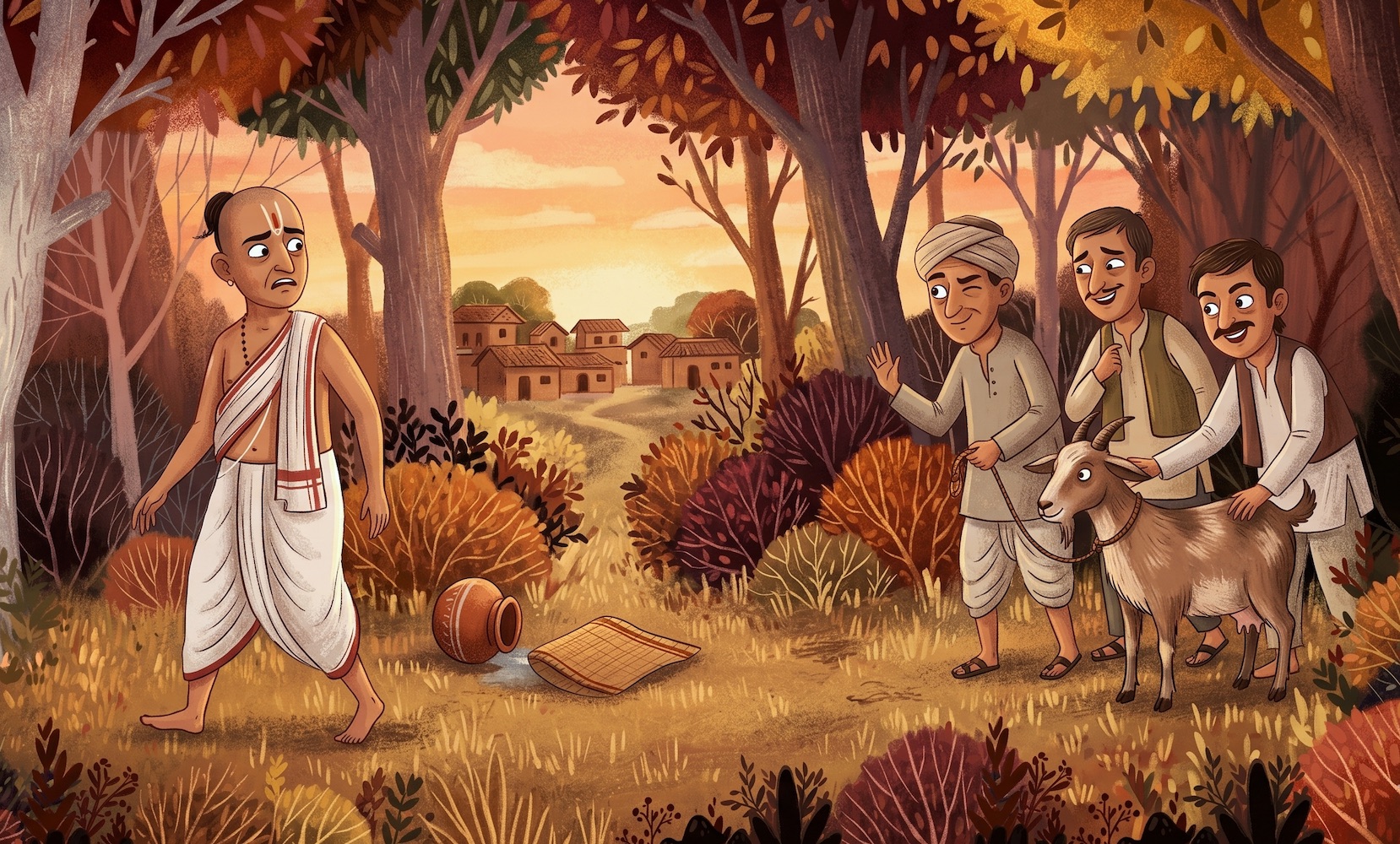
The Brahmin and the Goat: Trusting Your Own Perspective

A Brahmin, a goat, and three clever crooks. This ancient parable from the Panchatantra is a lesson in the dangers of "social proof." It serves as a vital warning: just because multiple people tell you the same thing doesn't make it true. It challenges us to trust our own senses and logic, even when the crowd is trying to convince us otherwise.

Critical ThinkingSelf-TrustDiscernment

The Brahmin and the Goat

In a small village in ancient India, a Brahmin named Mitra was performing a religious ceremony. As a gift for his services, a wealthy devotee gave him a plump, healthy goat. Mitra was delighted; he slung the goat over his shoulders and began the long walk back to his home, dreaming of the milk and wool the animal would provide.

Along the road, three hungry crooks watched him pass. They wanted the goat for their own dinner, but they knew Mitra was strong and would not give it up without a fight. "We cannot take it by force," the first crook whispered. "We must take it by trickery." They quickly devised a plan and spread themselves out along the path, a few hundred metres apart.

As Mitra approached, the first crook called out, "Honourable Brahmin, why are you carrying a filthy dog on your shoulders? Surely a man of your status should not touch such an unclean creature!" Mitra laughed. "A dog? Open your eyes, fool! This is a fine goat." He continued on his way, shaking his head.

A little further on, the second crook met him. He looked horrified. "Sir! Why do you carry a dead calf upon your back? It is a heavy burden for a man of your age." Mitra stopped, a flicker of doubt crossing his mind. He looked at the goat. It looked like a goat. It felt like a goat. "It is a goat!" he barked, though his voice was slightly less certain.

Finally, the third crook approached. He burst into laughter. "What a strange sight! A Brahmin carrying a donkey! Is your horse tired, sir?" Mitra's heart sank. He thought to himself, "One man might be mistaken, but three? Perhaps this creature is a demon that changes shape!" Terrified that he was carrying a cursed beast, Mitra dropped the goat and ran all the way home. The three crooks laughed, picked up the goat, and enjoyed a massive feast, all because they knew that if you repeat a lie often enough, even a wise man will start to believe it.


Share This

Bringing the Story Home

Use these notes to translate the story into a meaningful conversations.

Lesson behind the Tale

Do not let the crowd choose your truth. Just because three people say the same thing doesn't make it a fact. Real wisdom is having the courage to trust your own senses and your own logic, even when others are trying to convince you that you are wrong. If you know something is a "goat," don't let the world tell you it's a "dog."

Relating to Our World

In the age of social media and WhatsApp groups, our children are constantly bombarded with "The Three Crooks." For an 8-12 year old, this often looks like peer pressure: if three "cool" kids say a certain brand is bad, or a certain classmate is "weird," or a piece of news is true, your child will likely believe them—even if their own eyes tell them otherwise.

We can use this story to build their Mental Fortress. We want them to understand the concept of "Social Proof"—the psychological trick where we assume the majority is always right. By teaching them to pause and ask, "Does this match what I actually see?", we give them the tools to resist rumours and bullying. We want them to be the kid who keeps their "goat" because they know exactly what it is.

Opening the Dialogue

"Mitra knew he was holding a goat, but after the third person lied to him, he got scared and threw it away. Why is it so hard to believe ourselves when everyone else is saying something different?"

  • If they say 'You think you're wrong' "Exactly. We start to doubt our own brains. It's called 'Social Proof.' Have you ever seen a group of friends all agree on something—like a movie being bad—and even though you liked it, you felt like you had to agree with them just to fit in?"
  • If they say 'He was afraid of being laughed at' "That's a big part of it. Nobody wants to be the only person who sees the 'goat' when everyone else sees a 'dog.' But being a leader means being okay with being the only one who is right. How can we practice being brave enough to stay 'right' alone?"

"The crooks didn't use weapons; they just used words. Why are 'group lies' sometimes more dangerous than actual threats?"

  • If they say 'Because they trick your mind' "Spot on. A threat you can see and fight, but a lie makes you fight yourself. If a group at school starts a rumour about someone, does it become 'true' just because everyone is whispering it? What can you do to be the one person who stops the lie?"
  • If they say 'They make you give up' "They do. They make you give up your 'goat'—your values or your friendships. Next time you hear a 'story' about a friend from a few different people, will you believe it immediately, or will you go and see the 'goat' for yourself?"

Putting it into Practice

Let's go on a "Fact-Check Mission." Whenever you hear someone say "Everyone says..." or "Did you know that...?", I want you to stop and be a Brahmin. Ask yourself: Is there proof for this, or is this just a 'Three Crooks' story? Your challenge is to find one time today where you chose to trust your own eyes or your own logic instead of just agreeing with a group. How did you protect your 'goat' today?

Build Character, One Story at a Time

Nurturing values like integrity and courage doesn't happen overnight. Explore our full library of stories designed to help parents navigate every milestone.

Browse More Stories About Life

Recommend for You