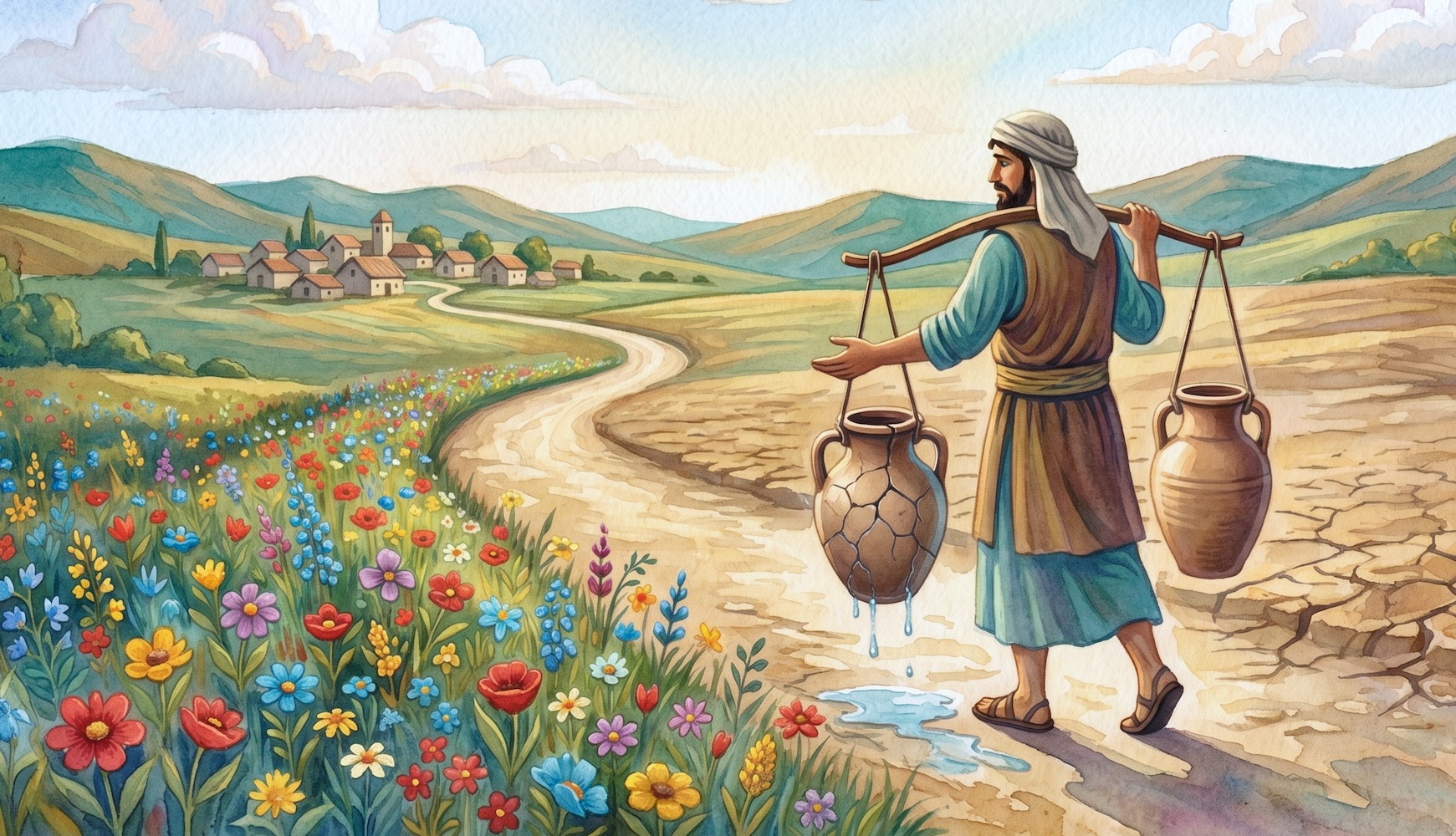
The Parable of the Cracked Pot: Embracing Your Child's Unique Wiring

Does your child have quirks, sensitivities, or differences that make you worry they won't fit into a rigid mould? The timeless parable of the cracked pot offers an essential shift in perspective for modern parents. It explores how a child's perceived vulnerabilities or deviations from "perfection" can silently cultivate unique beauty and strengths, challenging us to look past our anxieties and see the flowers growing along their path.

AcceptanceReframingIndividualityCompassionPerspective

The Parable of the Cracked Pot: The Beauty of the Leak

An ancient water bearer in India had two large pots, each hung on opposite ends of a long wooden pole which he carried gracefully across his neck. One of the pots was structurally perfect and always delivered a full portion of water at the end of the long walk from the stream to the master's house. The other pot, however, had a deep, jagged crack running down its side. By the time the water bearer completed his daily trek, this cracked pot had leaked half its contents, arriving only half-full.

For two consecutive years, this daily layout occurred without variation. The perfect pot was immensely proud of its accomplishments, viewing itself as flawless and perfectly suited to its purpose. But the poor cracked pot lived in a state of miserable shame, deeply mortified by its own internal imperfection and miserable that it could only achieve half of what it felt it was designed to do.

After two years of carrying this heavy burden of perceived failure, the cracked pot spoke to the water bearer down by the stream. "I am deeply ashamed of myself, and I want to apologise to you," the pot whispered. The water bearer paused and asked gently, "Why? What are you ashamed of?" The pot replied, "Because of my crack, water leaks out the side all the way back to your master's house. You do all this hard work, but because of my flaw, you do not get the full value of your efforts."

The water bearer smiled warmly, his eyes filled with profound compassion. "As we make the walk back to the master's house today," he instructed softly, "I want you to look closely at the side of the path."

As they climbed the hill, the cracked pot looked down and noticed, for the very first time, a spectacular array of beautiful, vibrant wildflowers blooming along its side of the road. Yet, even then, it felt a stab of sorrow at the end of the trail because it had still leaked out half its water. The water bearer turned to the pot and said, "Did you notice that the flowers were only blooming on your side of the path, but not on the perfect pot's side? That is because I have always known about your flaw. I intentionally planted flower seeds all along your side of the path, and every single day as we walked back from the stream, you seamlessly watered them. For two years, I have been able to pick these exquisite flowers to decorate my master's table. If you were not exactly the way you are, this beauty would never have existed."

Bringing the Story Home

Use these notes to translate the story into a meaningful conversations.

Lesson behind the Tale

Perceived flaws are often just unique features we haven't learned to reframe yet. In our rush to protect our children from societal friction, we can become completely consumed by a desire to mend every crack, correct every quirk, and smooth over every vulnerability. We treat their differences as structural failures.

But character is not an assembly line of uniform products. The very trait that makes a child "imperfect" in a standardised environment—such as intense sensitivity, unyielding stubbornness, or a highly atypical learning style—is often the precise tool that allows them to cultivate unique empathy, creative genius, or deep resilience.

Relating to Our World

The pressure to be a "perfect, leak-free pot" is intensely heavy. From an early age, our children are measured by their ability to retain and deliver full portions of expected outcomes—straight As, multiple enrichment accolades, flawless behaviour, and seamless social conformity. When a child "leaks"—whether that means struggling with processing speeds, exhibiting intense emotional sensitivities, or requiring an unconventional educational path—we as parents can fall into a trap of deep internal shame and panic. We look at our child and see a broken instrument that is wasting our parental investments.

But this anxiety is born from looking entirely at the destination while completely ignoring the terrain. A child who does not fit the standard academic mould is not a failed project. An intensely introverted child who struggles with large social matrices may possess a magnificent capacity for deep, independent focus. An emotionally sensitive child who cries easily under pressure is often the exact individual who will grow up to possess world-changing empathy and relational intelligence. Our primary duty as mindful parents is to stop staring resentfully at the crack and start noticing the wildflowers. We must reframe our domestic climate so that our children realise their unique wiring is not a deficit to be hidden, but a gift designed to water a completely different type of garden.

Opening the Dialogue

"Look closely at the specific trait or quirk in your child that causes you the most anxiety. If you were to stop viewing it as a 'crack,' what unique flowers might that trait be watering?"

  • If you are worried about their high sensitivity, anxiety, or emotional intensity Recognise that this thin skin is also the foundation for profound emotional intelligence, artistic insight, and deep loyalty to friends. They see and feel what others miss. Instead of trying to harden them or lecturing them to 'stop being so sensitive,' focus on helping them anchor their emotions so their sensitivity becomes a superpower rather than a burden.
  • If you are worried about their stubbornness, defiance, or unconventional thinking Realise that an unyielding will in childhood is often the raw material for immense leadership, moral courage, and entrepreneurial drive in adulthood. They are not easily swayed by peer pressure. Shift your approach from trying to break their will to gently guiding their focus, teaching them how to deploy their determination strategically.

"Reflect on your own history. What was your personal 'crack' growing up, and did you receive parental acceptance or constant pressure to fix it?"

  • If you grew up feeling fundamentally flawed or heavily criticized for your differences Be extremely mindful not to project that old trauma onto your child. Your panic when they struggle or fail to conform is often just a defensive echo of your own childhood wounds. Give yourself the compassion you never received, and actively choose to break the cycle by becoming the parent who stands fiercely between your child and societal comparison.
  • If you were blessed with parents who accepted and celebrated your unique wiring Channel that profound confidence into your daily routine. Remember how liberating it felt to grow without the suffocating weight of conditional approval. Replicate that safety for your child, ensuring that when they return home from a world that constantly critiques their performance, they step into a sanctuary of absolute acceptance.

Putting it into Practice

Identify the single behavioural friction point or trait in your child that has caused the most arguments or parental lecturing this month (e.g., their messy study layout, their slow morning routine, or their refusal to stand out in groups). For the next seven days, implement an absolute freeze on all criticisms or corrections regarding this specific issue.

Instead, your mission is to find a hidden strength embedded within that exact trait and explicitly praise it at least three times this week. If they are slow, praise their meticulous care. If they are quiet, praise their observational depth. Re-programme your own lens first, and watch how quickly their self-worth expands when they realise you are no longer trying to seal their cracks.

Build Character, One Story at a Time

Nurturing values like integrity and courage doesn't happen overnight. Explore our full library of stories designed to help parents navigate every milestone.

Browse More Stories About Life

Recommend for You