
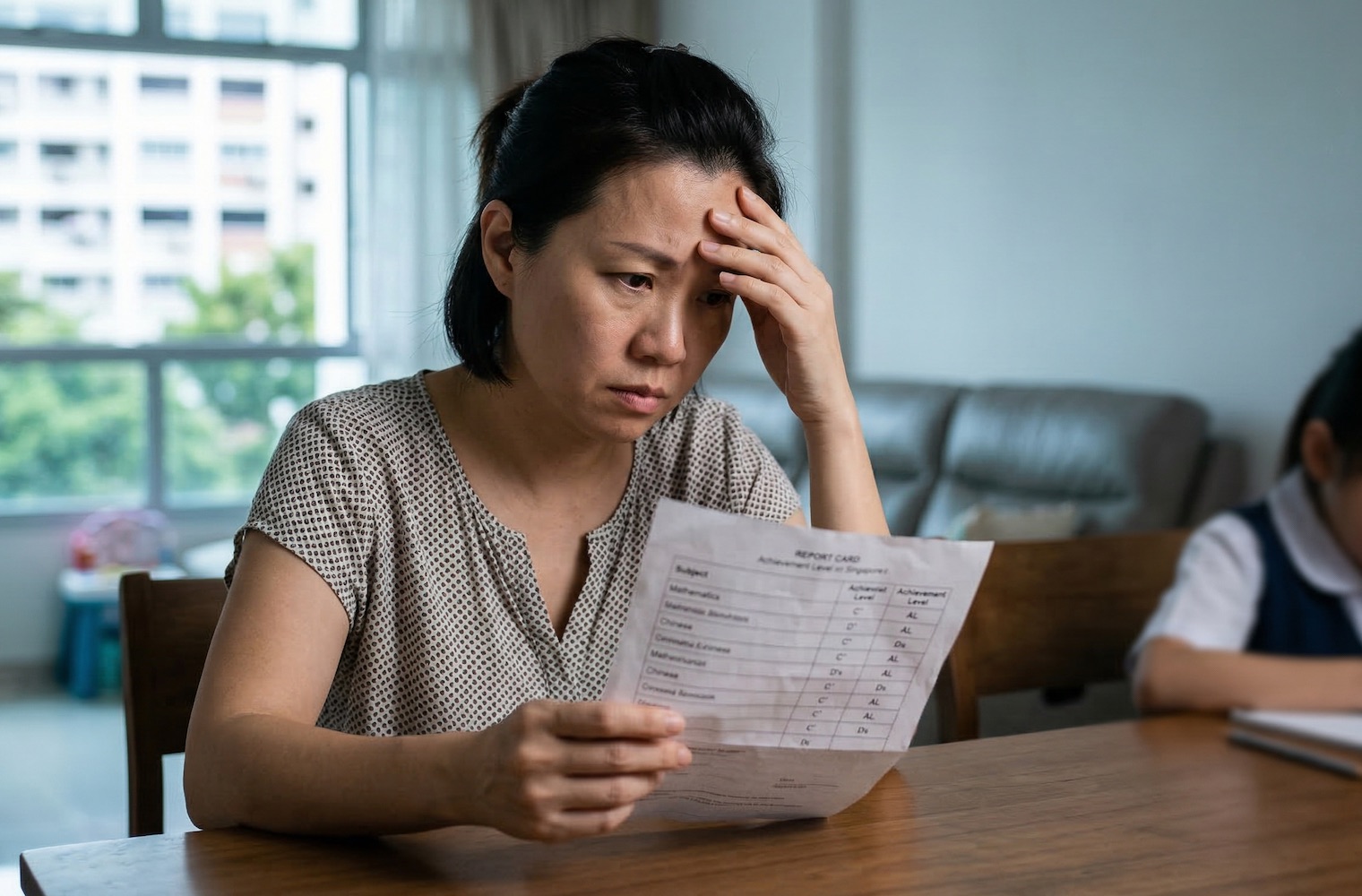
I hear the weight in your voice. It is a heavy thing, isn't it? To see that bright light in your child's eyes grow dim because of a single number on a white sheet of paper. My own son once sat at our dining table, his pencil snapped clean in half, muttering those exact words after a particularly gruelling Maths WA. It felt like a sharp tug on my heart. You aren't failing, and neither is your child. We are just dealing with a very loud world that tells them they are only as good as their last score.
Why those two words become a child's default setting
The smell of over-boiled kopi at the Nex food court. The auntie at the next table bragging about her grandson's Direct School Admission. The quiet, heavy silence from the child holding a 75-mark paper while their friend celebrates an AL1. These tiny moments stack up. Our children are like sponges. They soak up the unspoken rules of the room before we even open our mouths to speak. They see the way our eyebrows twitch when we look at a grade that isn't a "1" or a "2".
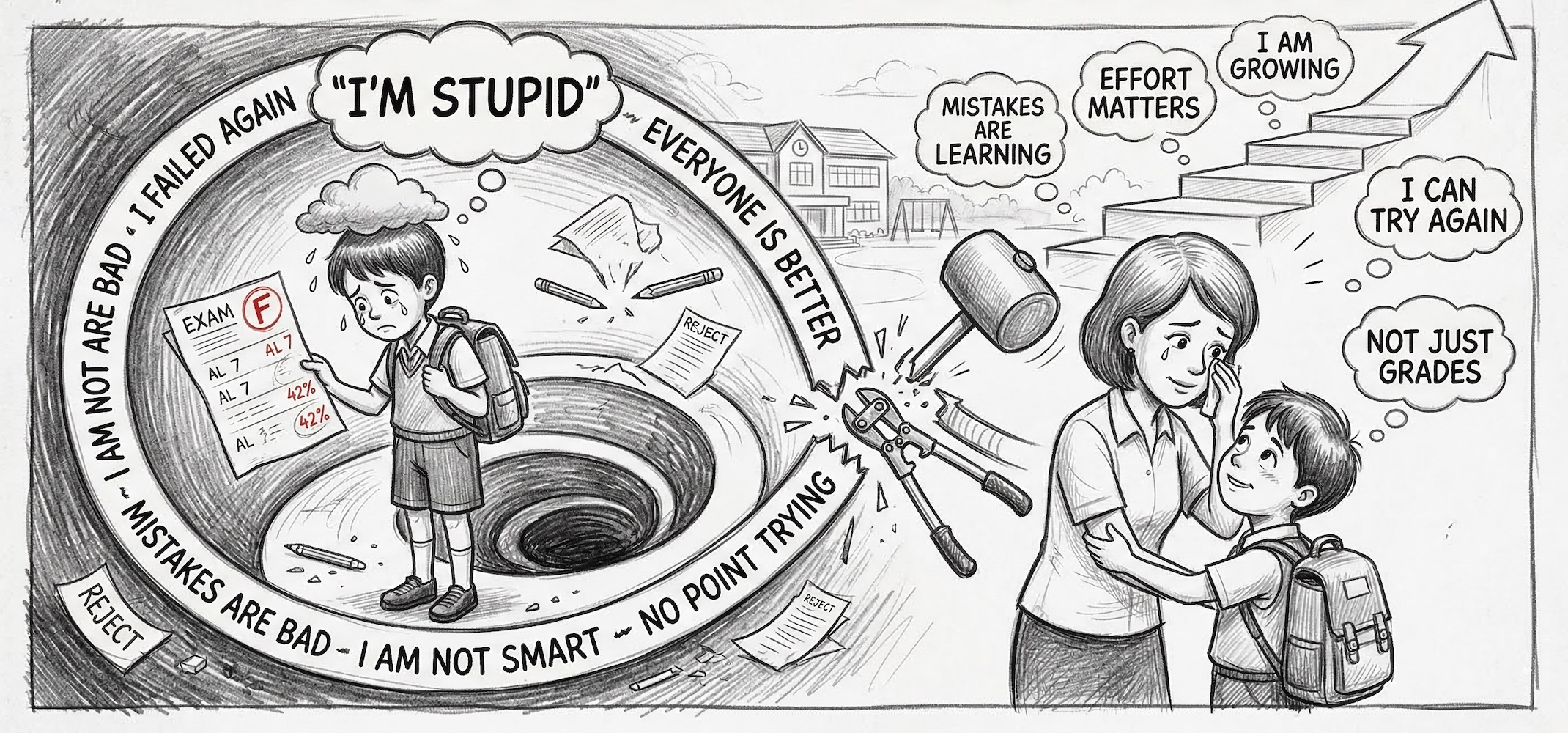
They often mistake our worry for disappointment. When we stress about their future or which secondary school they will get into, they don't hear "I want you to have a good life." They hear "You aren't enough as you are." The "I'm stupid" loop is usually a shield. If they say it first, it doesn't hurt as much when they think we might say it later. It is a defense mechanism against a system that feels like a mountain they can't quite climb. Sometimes, they just lack the words to say they are tired.
The hidden lens you might be holding up
We often look at our kids through a lens of "potential." We see what they could be if they just pushed a little harder or focused more during Chinese tuition. But when a child says "I'm stupid," they are looking through a lens of "identity." They are tying their worth to a grade. We need to swap these lenses. A grade is a data point, not a DNA result. It tells us they haven't mastered a concept yet, not that their brain is faulty. A children's self-esteem is built on "unconditional positive regard"—the idea that we love them because they exist, not because they performed. It sounds simple. In the heat of the exam season, it feels nearly impossible. But we have to try.
Turning down the volume on the inner critic
1. Give the "Mean Voice" a silly name
In our house, we call that negative self-talk "The Grumble-Bee." When my daughter starts saying she can't do her creative writing, I ask her if the Grumble-Bee is buzzing in her ear again. It externalises the problem. It isn't her that is stupid; it is just a pesky voice that needs to be swatted away. This gives her the space to breathe and try again without feeling like she is the failure. It works.
2. Celebrate the "Gritty" bits, not the "Easy" ones
Between the frantic morning rush to get to the bus, the forgotten water bottles, the crumpled spelling lists in the bottom of school bags, and the constant pings from the class WhatsApp group, we sometimes forget that our kids are just little people trying to make sense of a very loud world. It's exhausting. We should stop praising the AL1 that came easily. Instead, we should make a big deal when they spend forty minutes trying to solve one tricky heuristic problem, even if they get it wrong. Praise the "grit," the "sweat," and the "staying power." That is what builds a person.
3. Watch your own "Ouch" moments
I caught myself the other day. I dropped a plate in the kitchen and sighed, "Ugh, I'm so clumsy and useless." My daughter was standing right there. If I call myself names for small mistakes, she learns that mistakes define us. I had to stop and say, "Wait, I'm not useless. I just had slippery hands. I'll clean it up." We have to model how to be kind to ourselves. If we don't show them how to handle a "fail," they will never learn to do it themselves.
4. Change the "Win" conditions
What if the goal of the week wasn't "no mistakes on the practice paper"? What if the win was "I asked the teacher a question when I was confused"? Or "I helped a friend with their science project"? When we widen the definition of success, the "stupid" loop loses its power because there are so many other ways to be "smart." A child who is kind, curious, or resilient is far more prepared for the world than one who only knows how to shade bubbles on an OMR sheet.
5. The Power of "Yet"
This is a small tweak that carries a lot of weight. When they say "I don't get this," we gently add "Yet." "I'm not good at Fractions... yet." It suggests that life is a long pavement we are walking on, not a wall we've hit. It keeps the door open for growth. It turns a dead end into a detour.
The question you must ask before the next report card
Your child is more than a digit in a database. They are the way they laugh at the cartoon in the Sunday Times, the way they share their snacks at the playground, and the way they try so hard to please us. Grades will fade. The way you made them feel when they were struggling will stay. The next time that report book comes home and the numbers aren't what you hoped for, take a breath. Look at that little face looking up at you. Ask yourself this: If my child never gets an AL1 in their life, will I still be proud of the person they are becoming right now?