
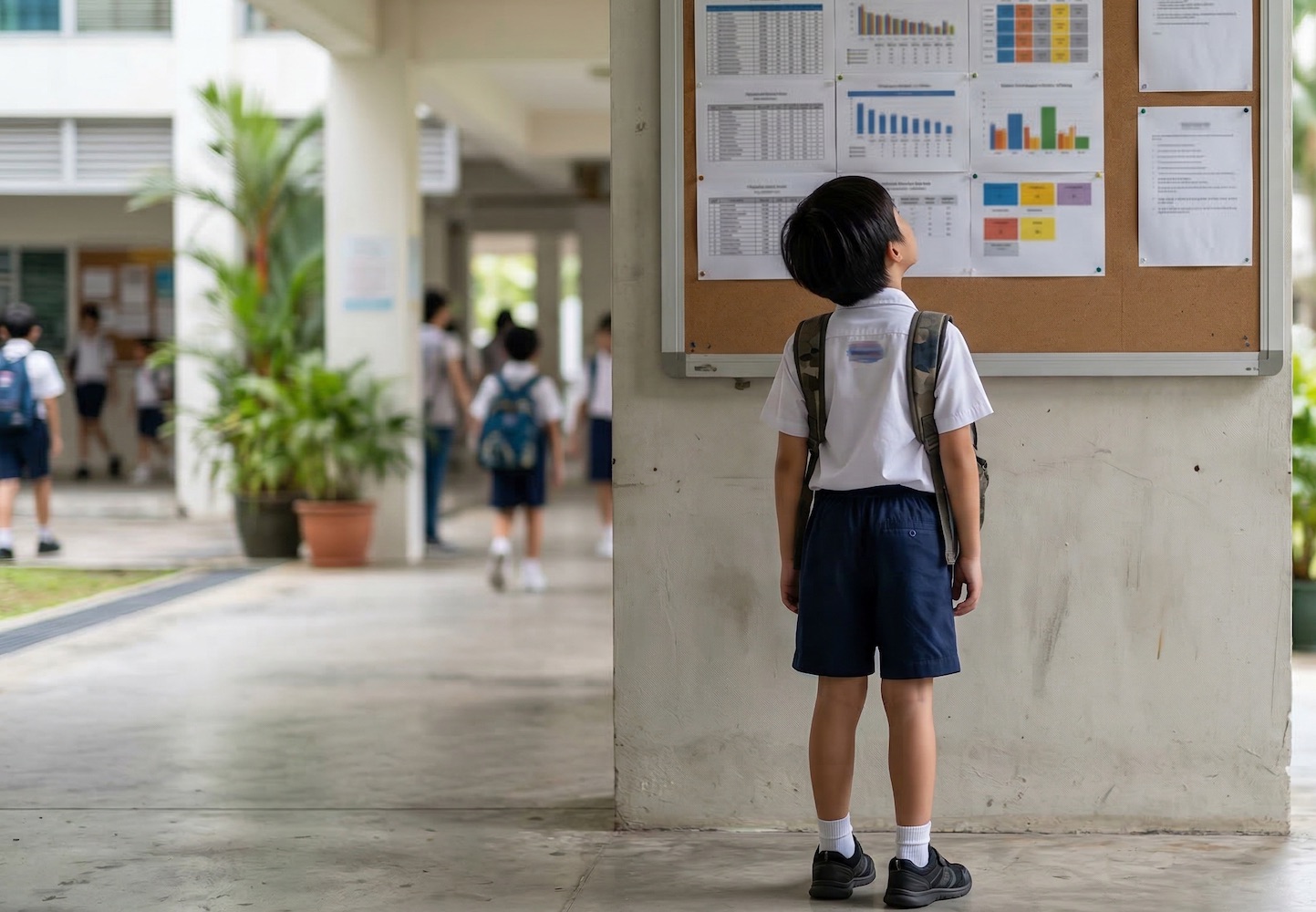
I hear the worry in your voice. Just yesterday, sitting on a wooden bench near the Bukit Timah Rail Corridor, I watched a young boy frantically checking his spelling list while his friends played tag, his face tight with a kind of stress no seven-year-old should carry. It is a heavy burden to bear. To feel like your worth is tied to a list on a whiteboard or a percentile on a report book is exhausting for a little heart. You aren't alone in this, and honestly? Neither is your child. We want our children to strive for their best, but when that striving turns into a painful comparison with the "top student," the joy of learning just vanishes. It is okay to feel concerned, and it is okay to want something different for them.
The ghost that sits in the front row
The smell of fresh ink on a report book can be intimidating. Sometimes this obsession starts with a simple "Wah, so clever" directed at another child. Children are like little radars; they pick up the tiniest signals of what adults value, whether it is the extra sticker on a classmate's worksheet or the way we lean in when someone mentions a high score. They aren't trying to be competitive for the sake of it. They are trying to find their place in the pack. In a high-pressure environment like a Singaporean classroom, being "the best" feels like the only safe place to stay.
Then there's the chatter at the school gate or in those "Mummy" WhatsApp groups. Even if we don't say it to them directly, they hear us asking about the median score or who got into the higher-tier CCA. It's in the air. They begin to believe that love or approval is a limited resource, something you have to win by beating someone else. It makes the classroom feel like a battlefield rather than a playground. When every mark is a point in a race, the actual lesson gets lost in the dust.
Breaking the spell of the number one
A single hibiscus flower doesn't care about the rain tree next to it. It just grows. We need to shift the focus from the "rank" to the "reach." If your child is reaching further than they did yesterday, that is the only metric that should count. The top student is just another child on their own path, dealing with their own mess. Their success doesn't take anything away from your child's brilliance. There is room for everyone to bloom. When we stop looking at the leaderboard, we start looking at the child standing right in front of us.
We often think that pressure creates diamonds. But sometimes, it just creates cracks. By reframing the "top student" as a peer rather than a target, we help our children see school as a community. Success isn't a zero-sum game. Helping them realise that another person's "A" isn't their "F" is the first step toward a quieter mind.
Building a heart that doesn't need to win
1. Celebrate the grit, not the grade
The sweaty forehead. The chewed pencil. The way they sat for twenty minutes trying to figure out that one tricky heuristic problem in their maths workbook while the afternoon sun hit the floor tiles. Those are the moments to cheer for. When they finally "get it," focus on the persistence it took to get there. "I saw how hard you worked on that" carries so much more weight than a compliment about a score. It teaches them that their effort is what you value most. Truly.
2. Audit your own "Comparison Talk"
It happens so easily. We ask who else got full marks or how the rest of the class did. Try to stop. Just... stop. When they bring up the top student, acknowledge it briefly and then pivot. Ask how they felt about their own work. By making the other child's rank a non-event, you signal that it is not the main character in your child's story. It takes the power away from the list. It makes the world feel a bit bigger.
3. Introduce "Personal Bests"
Think of it like a marathon runner at East Coast Park. They aren't racing the professional at the front; they are racing their own clock. Help your child track their own progress over time. Show them a piece of writing from last year compared to now. The difference will be huge. Seeing that tangible growth helps them realise that the only person they need to beat is the version of themselves from six months ago. Progress is a personal journey, not a public race.
4. Expand the definition of success
Is the top student the kindest? Are they the best at sharing their snacks or helping a friend who fell down on the pavement near the canteen? We need to highlight these "soft" wins. If we only talk about grades, they think grades are the only things that matter. Praise their empathy. Praise their curiosity. My daughter once spent an hour watching a trail of ants, and that curiosity is worth more than a perfect score on a science quiz. Character lasts longer than a semester ranking.
The question you haven't asked yet
Your child is more than a number. They are a whole, wonderful human being with a heart that beats for more than just marks. The next time they come home upset because they aren't "the best," take a breath. Hold them close and let the silence sit for a moment. They need to know they are enough, exactly as they are, without a single trophy to their name. It starts with us. If we aren't chasing the ranking, they eventually stop running that race too.
When you look at your child tonight, can you see the person they are becoming, or are you still looking for the student they are supposed to be?