
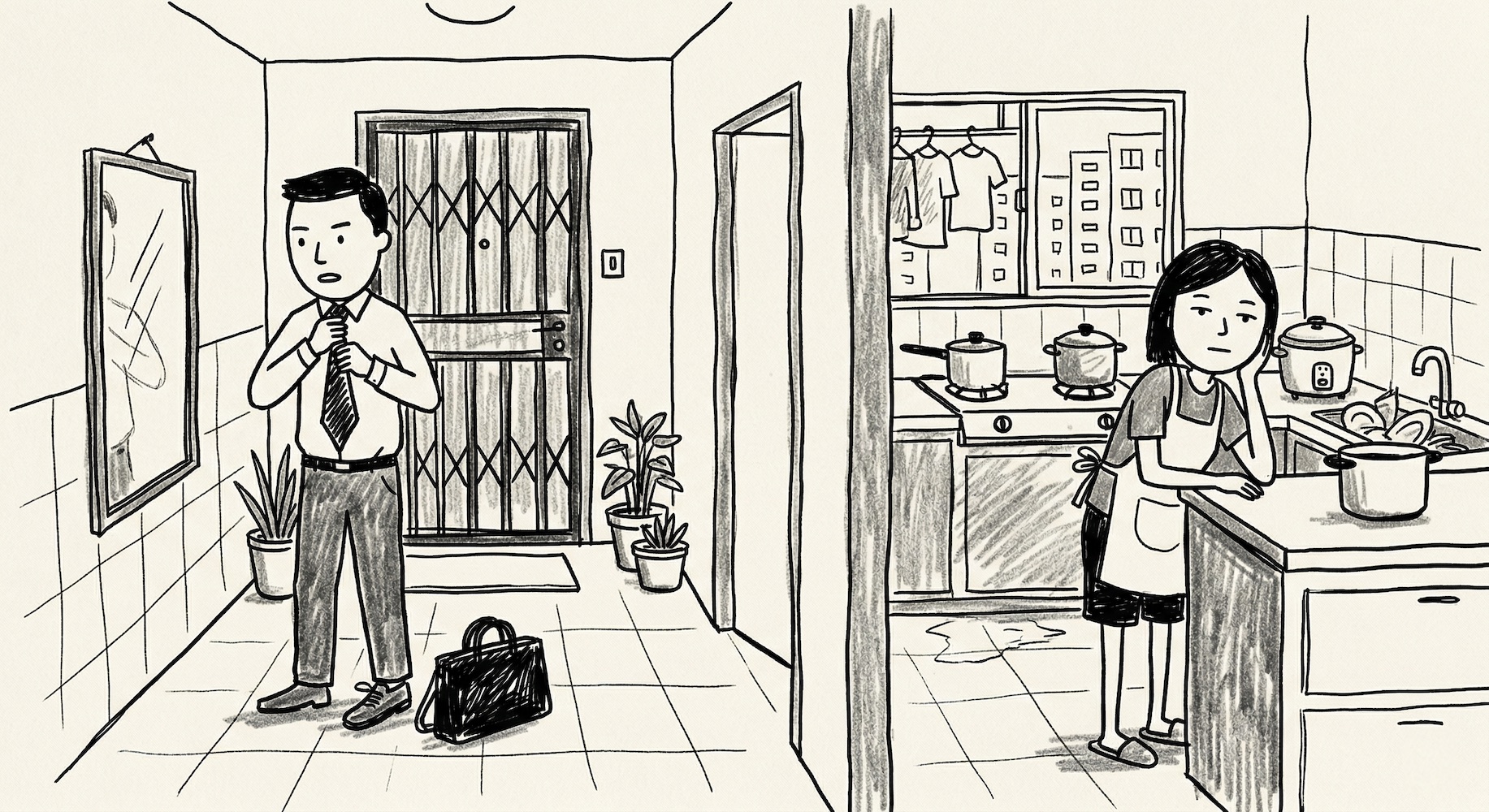
You love your children and your partner, yet there is this persistent ghost of the career you thought you would have by now. Please know that it is okay to mourn the "what ifs" while still being a devoted parent. You are not ungrateful for your life; you are simply human, and your ambitions matter just as much as your family's schedule.
The silent trade-off you didn't see coming
The smell of cold kopi-o on a Tuesday morning while the laptop fan whirs beside a stack of primary school worksheets. I've sat there too. Often, this resentment builds because the "mommy track" isn't a choice we made in a vacuum, but a series of small, necessary surrenders to keep the household running. You're the one who can leave the office at 4:30 PM for the enrichment class pickup, or the one who stays home when a fever strikes because your job is "more flexible."
Societal expectations in Singapore still lean heavily on the mother being the "default" parent, even when both partners work. We see the career of the higher earner—often the father—as the one that must be protected at all costs. This creates an imbalance where one person's professional growth is fed by the other's stagnation. It is a slow burn. The resentment isn't usually about the work itself, but about the lack of recognition for the professional cost you are paying every single day.
The mirror that shows a version of you that's gone
I remember finding an old office lanyard at the bottom of a drawer once, from a time when my biggest worry was a board presentation rather than whether my son had his spelling list ready for school. It felt like looking at a stranger. We often tie our self-worth to our professional titles and the speed at which we climb the ladder. When you take a role with less "prestige" just to ensure someone is home for dinner, it feels like a part of your identity has been erased.
Maybe it's the sound of your partner's late-night calls that remind you of a rhythm you once knew, a pace that felt like your own before the nappies and the school runs took over. It hurts. We tend to view this period as a "loss" rather than a "season." If we only look at what we are missing, we stop seeing the person we are becoming in the quiet spaces. This shift in perspective isn't about lying to yourself, but about acknowledging that your value hasn't actually dropped; the market just hasn't figured out how to measure it yet.

Turning the quiet resentment into a shared plan
1. The 'Time Audit' that reveals the truth
Sit down with your partner and map out every single "family task" that happens in a week. Don't leave anything out—the mental load of remembering school holidays, buying birthday gifts, and checking the pantry. Often, partners don't see the "mommy track" as a sacrifice because they don't see the sheer volume of work it covers. Seeing it written down on paper can be a huge wake-up call for everyone. It makes the invisible visible.
2. Finding your own 'Third Space'
You need a space that belongs to neither the office nor the kids. For me, it's a 20-minute walk around the park near our place after the school run. No podcasts, no errands. Just me. It sounds small, but reclaiming even a tiny bit of your day for something that isn't "useful" to anyone else is a way to tell your brain that you still exist as an individual. Use it to read, to sketch, or just to sit in the quiet. It helps.
3. Having the uncomfortable money talk
Resentment often hides in the bank account. If one partner has a slower career trajectory for the sake of the family, the family finances should reflect that it is a joint effort. Discuss how "family wealth" is shared and ensure the partner at home or on the "flexi-track" has equal access and security. It is about respect. This removes the feeling of being a "dependent" and restores the sense of being a co-pilot in the marriage.
4. Redefining what a 'Win' looks like today
The sticky table at the hawker centre, the constant ping of the school WhatsApp group, the piles of laundry that never seem to shrink, and that nagging feeling that your CV is gathering dust while your peers are getting promoted—it all adds up. But perhaps a "win" this year isn't a promotion. Perhaps it is the fact that you know your daughter's favourite story by heart, or that you've kept your sanity intact during a global shift. Adjust the metrics. Not forever, just for now.
The question to ask when the house finally goes quiet
Your career is a long story, and this chapter, while frustrating, is not the whole book. Many of the most successful people I know took "detours" that later gave them a perspective their peers lacked. Be gentle with yourself. You are doing something incredibly difficult, and your feelings of frustration are a sign that you still have fire in you—and that is a good thing. Don't let that fire turn into a bridge-burning resentment toward your partner; use it to light the way toward a new arrangement that feels fair.
Tonight, when the kids are finally asleep and you're folding that last load of clothes, ask yourself: if I could change just one small part of our daily routine tomorrow to feel more like "myself," what would it be, and why haven't I asked for it yet?