
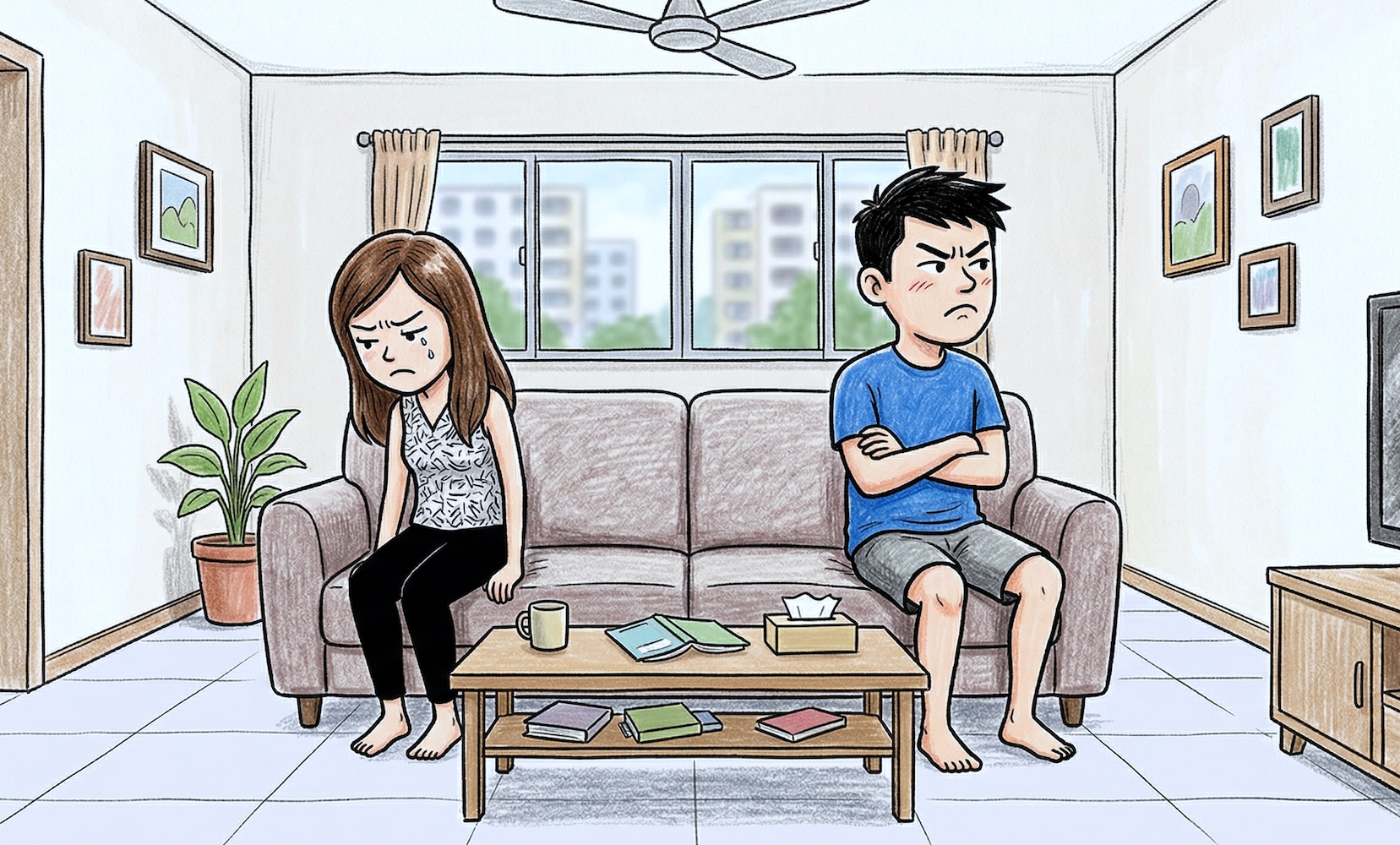
That sharp, cold prickle of "not enough" that arrives right after a family dinner or a quick scroll through a sibling's holiday photos. You are sitting in your home—the place where you've tucked your children into bed and shared a thousand quiet cups of Milo—and suddenly, the walls feel a bit too close, the floor tiles a bit too old. It isn't just about the property title or the swimming pool access; it is about the fear that your own hard work and the life you've built with your partner are somehow second-rate.
The silent reason your sister's lifestyle feels like a personal attack
I recall seeing a young couple arguing near the barbecue pits at ECP. They weren't shouting about the heat, but about a "new car" someone else had bought. We live in a city where success is often measured by how high up you live or how many car segments you can afford. When your partner looks at your sister's husband and sees a condo, they aren't just seeing a building; they are seeing a report card. They might feel like they are failing a test they didn't even know they were taking. It's a mix of "kiasu" culture and a deep-seated need for security that gets twisted into a competition.
Sometimes, this comparison comes from a place of exhaustion. When the kids are screaming, the washing machine is acting up, and the bills arrive all at once, the idea of a "luxury condo" represents an escape from the mess. It is easier to blame the lack of a private gym than it is to deal with the raw stress of daily parenting. We use these "missing" things as shields to protect us from admitting we are simply tired or overwhelmed. It is a distraction from the real work of being present with what we have right now.
What you are actually counting when you look at their bank balance
I remember standing in the queue at the Kovan market, watching an elderly uncle carefully count out his coins for a bowl of lor mee, his face completely at peace. He wasn't looking at the fancy cars driving past toward the newer developments. We often confuse "standard of living" with "quality of life." A condo provides a lift lobby and a guardhouse, but it doesn't guarantee a laugh that shakes your chest or a partner who stays to help with the dishes after the kids have finally fallen asleep. You are comparing your "behind-the-scenes" footage with your sister's "highlight reel," and that is a game you will always lose.
Reframing this means looking at the trade-offs. Perhaps that condo comes with a mortgage that keeps them awake at night or a job that means the father is never home to see his children eat dinner. Your four-room flat or your modest rental is a space where your children feel safe. It is the container for your memories, not the definition of your worth. When you look at your partner, try to see the man who shows up, not just the man who earns. The currency of a happy home isn't found in the CPF statement, but in the patience you show each other when the morning routine goes completely wrong.

The small shifts that stop the "condo talk" from ruining your dinner
1. Create a "Comparison-Free" Zone
Decide together that certain times of the week are off-limits for talk about money or other people's achievements. Sunday afternoons at the park or late-night dessert runs should be for your family only. If the topic of the sister's husband comes up, gently redirect it back to your own plans. Use a simple phrase like, "I'm happy for them, but let's focus on our own weekend goals today." It protects your mental space from the noise of outside expectations.
2. Audit Your Social Media Consumption
If seeing those property tour videos or "moving-in" vlogs makes you feel bitter, stop watching them. The algorithm doesn't care about your peace of mind, but you should. Unfollow the accounts that trigger that sense of inadequacy. Replace them with content that celebrates the life you actually live, like local hobby groups or simple recipe ideas. It is much harder to feel "poor" when you aren't constantly staring at someone else's "wealth."
3. Practice Radically Honest Financial Talk
Instead of letting the "Why can't we afford it?" question hang in the air like a heavy cloud, sit down and look at the numbers. Discuss what you are willing to give up to get that condo. Are you willing to work twelve-hour days? Would you sacrifice your yearly family trips to Malaysia or the children's enrichment classes? Often, when we see the "cost" of the dream, the dream loses its shine. It makes the situation a choice you've made together, rather than a failure you're suffering through.
4. Celebrate the "Small Wins" Weekly
The sticky residue of a half-eaten mango on the table, the pile of damp towels by the bathroom door, and the looming deadline for the school field trip forms all seemed to blur together as I stared at my reflection in the dim hallway mirror while my husband snored softly in the next room. Total chaos. But we had paid off the credit card bill that month. Every Friday night, mention one thing you are proud of that has nothing to do with money. Maybe your son learned to tie his laces, or your daughter shared her snacks without being asked. These are the real riches.
5. Build a "Shared Vision" Board
Get a physical piece of paper and write down what you want for your family. Not what society says you should want. If your goal is to travel more or to retire early, focus on those steps. When you have your own map, you stop worrying about which road everyone else is taking. It gives you a sense of agency. You aren't "unable to afford a condo," you are "choosing to prioritise other things."
How to tell if you are winning at a game you never signed up for
Comparison is a thief that works in the dark, whispering that you are falling behind. But you are not a competitor in your sister's life; you are the lead character in your own. Your home is where your children's stories begin, and they won't remember the marble countertops as much as they will remember the feeling of your hand in theirs. Stop looking across the fence. The grass is greenest where you choose to pour the water.
Next time you feel that sting of comparison, ask yourself this: If no one else could see where you lived, would you still feel like you were missing out?