
You are staring at a text with your retired mother at eleven o'clock on a weeknight, carefully negotiating her availability to watch your only child next Tuesday afternoon. Your calendar is balanced around a precarious house of cards: if your helper falls ill or your parents face a sudden medical checkup, your entire professional and domestic schedule falls apart. You are convinced that parenting is a logistical impossibility without a dedicated, live-in support crew on permanent standby.
We tell ourselves that we are holding back family expansion out of sheer practicality. We look at the absence of retired relatives living down the corridor, the lack of an available spare room for a live-in caregiver. But by making family satisfaction and growth dependent on the availability of external reinforcement, we might be keeping our households locked in a cycle of constant vulnerability.
The Village Dependency Myth
Many of us freeze our family plans because we are waiting for a perfect external network or a live-in grandmother to appear. We convince ourselves that expanding our household is an impossible hurdle unless we have an army of external helpers on standby. But Darryl, a 41-year-old father of three living in Hillview, discovered the flaw in relying on external structures when reality tested his household framework.
"During the month my wife was unexpectedly hospitalised, our entire routine fractured, and I was running on empty trying to keep our household running," Darryl shares. "It was only when I walked into the living room and saw my nine-year-old patiently coaching his younger sister through her spelling list that I realised the sibling unit was the only self-sustaining support system we actually had."

When we look honestly at parenting culture, several unvarnished truths emerge about why relying on an external village is a misconception, and why waiting for outsourced reinforcement before having a second child is a miscalculation:
-
The Help-First Stagnation DelusionBelieving you must withhold family expansion until a perfect childcare network is secured keeps you in permanent hesitation. You pass up the chance to grow your family while waiting for ideal external conditions that rarely manifest in modern urban life.
Failing to move forward because you lack an outsourced village means you miss out on building a natural and resilient domestic structure.
-
The Co-Residency Harmony FallacyAssuming that moving grandparents into your flat or condominium creates a frictionless childcare setup is a major oversight. Merging three generations under one roof often introduces complex emotional friction and conflicting viewpoints on discipline.
This underlying daily tension exhausts your mental energy far quicker than managing a larger family independently.
-
The Caregiver Single-Point VulnerabilityDepending entirely on an external village layer, like a retired relative or a sole helper, leaves your family operations highly exposed. As Darryl experienced firsthand, when your single external pillar faces an unexpected challenge, the entire household routine breaks down.
True stability requires a system that generates its own cooperative backup options within your own household.
-
The Infinite Grandparent Stamina MythExpecting ageing parents to possess the long-term physical endurance required to raise multiple young children is unrealistic. While their willingness is genuine, their physical strength is finite, and their own healthcare requirements will naturally increase over time.
Relying on them as your core operational infrastructure creates an unsustainable long-term arrangement.
-
The Modern Estate Proximity IllusionWaiting for an old-school community spirit to spontaneously form behind the closed doors of modern estates is an ineffective strategy. Your busy neighbours are fully occupied with their own corporate responsibilities and packed schedules.
Withholding the decision to have another child because you lack an external village ignores the fact that internal networks are far more reliable.
Fostering Internal Abundance
It is time to reformulate how we view family architecture. We are conditioned to look at our time, energy, and bank accounts as a fixed pie that must be divided into smaller, less satisfying slices if another child arrives. This adjustment assumes that every additional family member is a drain on resources rather than a creator of new ones.
When you introduce a second child, you are not just adding another dependent; you are creating a relationship that offsets your workload over time. Sibling dynamics introduce natural socialisation, negotiation skills, and companionship that you no longer have to manufacture through expensive commercial play zones or weekend entertainment schedules.
True family resilience comes from multiplying your internal relationships rather than dividing your material resources.
Steps to an Independent Family Ecosystem
Moving away from a dependency on external helpers requires a step-by-step transition toward internal reliance. Kym, a 38-year-old mother of two living in Admiralty, discovered that expanding her family actually provided the structural ease she was looking for.
"I used to spend every single weekend driving my eldest to premium indoor playgrounds just so she wouldn't be lonely, which drained our wallet and our energy," Kym reflects. "Once her younger brother was born and old enough to interact, they began inventing their own elaborate imaginary games at home, and I realised that a sibling was the best, most cost-effective investment we could ever make for her development."

If you want to start building a self-sustaining support system inside your own walls today without relying on live-in help, follow these five progressive steps:
-
Cultivate Peer-to-Peer Problem SolvingStep back from the role of full-time mediator and allow children to resolve their minor conflicts independently. When you stop intervening during living room disputes, children naturally develop essential negotiation skills.
This deliberate withdrawal reduces your emotional load and builds an independent communication framework between siblings.
-
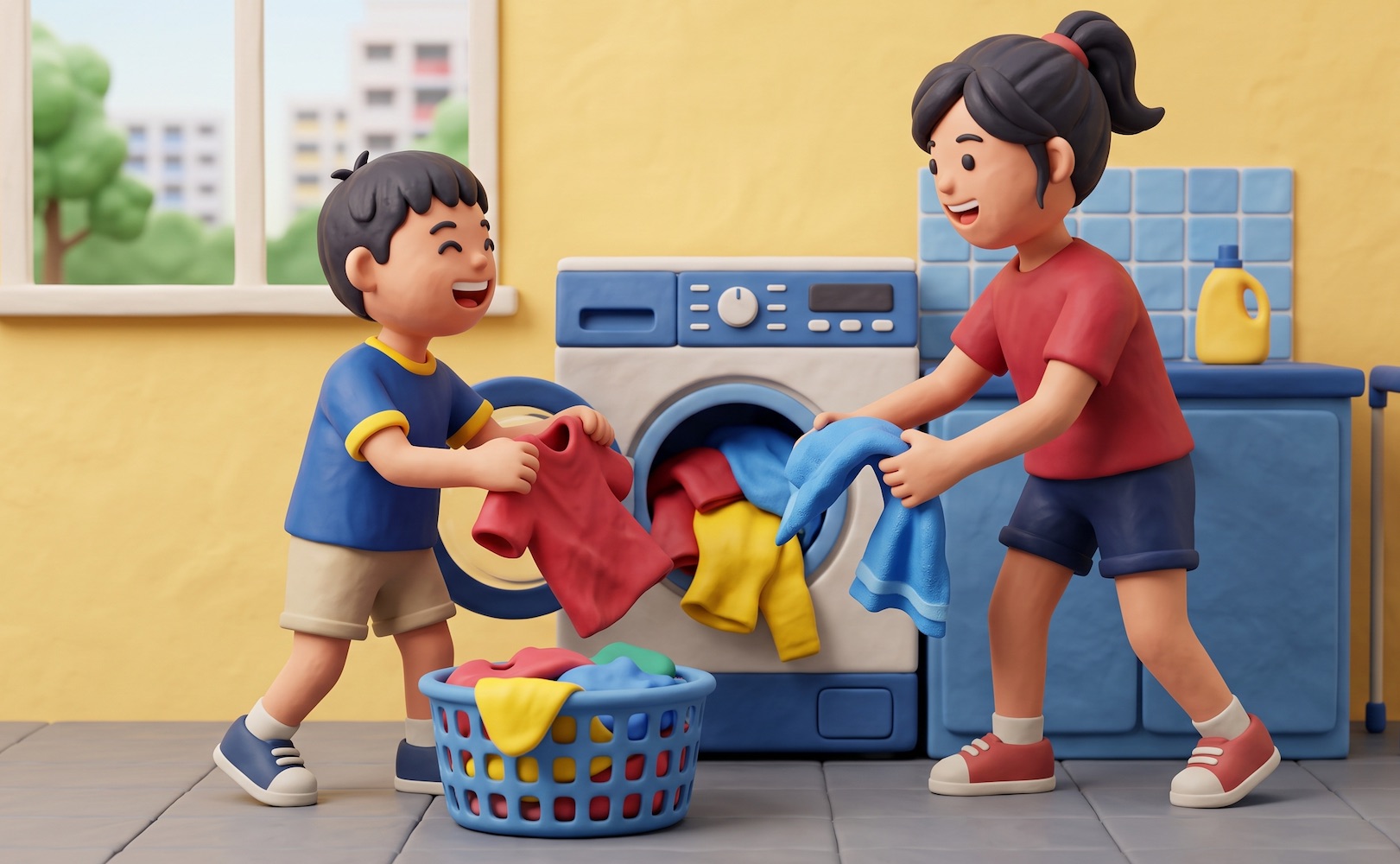
Design an Internal Caregiving LadderTrain your older child to take genuine responsibility for simple caregiving tasks involving the younger sibling. This includes guiding them through morning routines, packing school bags, or assisting with basic spelling reviews.
This regular practice fosters deep sibling bonds while freeing up vital pockets of parental time.
-
Synchronise the Household Routine GridAlign the daily schedules of your children to create predictable, overlapping windows of activity and rest. When mealtimes, homework sessions, and play hours run in parallel, the household begins to operate with automated efficiency.
You no longer need to coordinate separate logistics for each individual child throughout the weekend.
-
Phase Out Premium Commercial OutsourcingRemove the habit of using expensive commercial play zones as the default solution for childhood entertainment. By allowing children open, unstructured time together at home, they learn to cooperate using existing household resources.
This simple adjustment lowers your monthly expenses while strengthening internal play dynamics and mutual reliance.
-
Embed Collaborative Domestic TasksIntroduce shared household chores that strictly require cooperative effort from your children to complete successfully. Tasks like clearing the dinner table, organising toy storage, or watering balcony plants should be assigned to the sibling team.
This practice establishes a culture of internal mutual support that functions without constant parental prompting.
Owning Our Independence with #IWantMoreSG
At the end of the day, the true measure of family durability is not how much external assistance you can secure, but how self-reliant your home can become. We often stall our family plans because we feel exposed without a live-in grandparent or a permanent circle of helpers on standby. We spend years operating under the false assumption that we are completely vulnerable unless someone else is managing our domestic details.
But real stability means building a household that functions beautifully on its own terms, free from the constant need for outsourced reinforcement. True resilience is realising that you do not need to wait for an external village to validate your choice to expand. You possess the capability to cultivate an independent, functioning ecosystem right inside your own living spaces.
Choosing to grow your family is an intentional decision to stop relying on others and start trusting the strength of your immediate household. It is a confident step away from external dependency in favour of a home that stands firmly on its own feet, generating its own companionship and daily support.
By focusing on self-reliance, we can embrace a liberating new perspective under #IWantMoreSG. It is a desire to move past the need for an outsourced support structure, choosing instead to build a proud, capable, and deeply connected family unit that takes care of its own.