
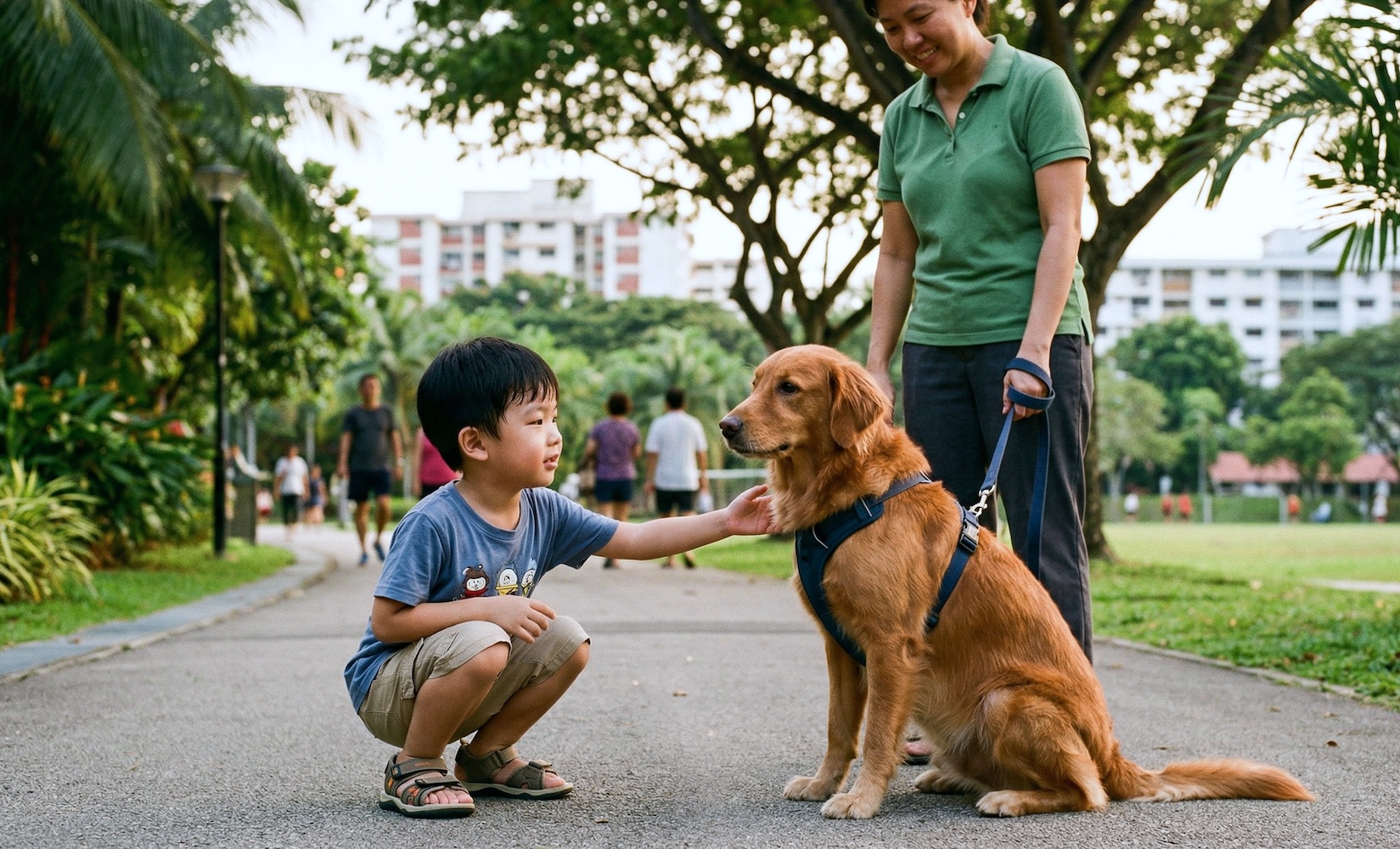
I remember standing near the taxi stand at Westgate a couple years ago, and my heart doing a little somersault as my youngest lunged toward a massive, fluffy Chow Chow. The owner looked surprised, the dog looked bored, and I felt that familiar mix of pride in her kindness and absolute terror for her safety. It is a common struggle for us parents. We want to raise children who see the good in people, yet we live in a world where boundaries are necessary for their own protection. If you are feeling exhausted by the constant "come back here!" or the "don't touch!", please know you are not alone in this. Your child has a big heart, and that is a beautiful thing, even if it keeps your nerves on edge.
Why your little one treats the whole world like a familiar living room
The smell of wet grass and the sound of distant traffic usually fill the air when these moments happen. Children under the age of seven often lack the "brakes" in their brain to stop a physical impulse once it starts. When my son sees a wagging tail, his brain registers "joy" long before it registers "danger" or "permission." Their prefrontal cortex is still under construction, meaning the signal to run is much faster than the signal to think. It is just biology at work. They aren't being naughty; they are being driven by a system that hasn't fully wired the "stop" button yet.
Many kids also struggle with "social cues" because they assume everyone is as friendly as their own family. To a five-year-old, a stranger is just a friend they haven't met yet. They don't see a "stranger"; they see a person with a cool hat or a dog with a shiny collar. Their world is small, safe, and filled with people who love them, so they project that safety onto every pavement and lift they enter. They simply don't have the life experience to know that not every dog is friendly or every person is safe.
Turning a safety fear into a lesson about respect
I was frustrated after chasing my daughter away from a group of teenagers for the third time. I had to stop and breathe. Instead of seeing this as "disobedience," I started looking at it as "untrained empathy." When we see it as a flaw, we react with anger. When we see it as a lack of skill, we react with teaching. Your child isn't trying to scare you or put themselves in harm's way. They are simply vibrating with an energy that wants to connect with the world around them.
We can shift our perspective from "stop being so friendly" to "let's learn how to ask." This changes the energy of our parenting. Instead of shutting down their light, we are just putting a lampshade on it so it doesn't burn too bright or in the wrong direction. We aren't teaching them that the world is a scary place full of monsters. We are teaching them that every person and every animal has a "bubble," and we need to be invited into that bubble before we enter. It is about respect, not just fear.

Simple steps to build a safety bubble without crushing their spirit
1. The "Hand on the Bag" Rule
Whenever we are in a crowded place like the mall, I tell my children they must have one hand on my handbag or my pocket before they can look at anything. This physical connection acts as a literal anchor. It keeps their bodies close while their eyes wander. If the hand comes off, we stop moving entirely. It is a simple, non-verbal way to keep them within arm's reach without constantly shouting their names across the pavement.
2. The Three-Question Check
We practise this at home using stuffed toys. Before they can touch the "dog," they have to ask me: "Mummy, can I see?", then ask the owner: "Can I pet your dog?", and finally wait for the dog to sniff their hand. We make it a game. By breaking the interaction into steps, we create a "speed bump" in their thought process. They learn that "seeing" does not automatically mean "touching." This delay gives their brain time to catch up with their feet.
3. Using a "Safety Word" for Dogs
Try using specific language for animals. We use the word "Working" or "Resting." I explain that some dogs are "working" on a walk and shouldn't be bothered, while others are "resting" and need their space. This gives the child a job—they become a "detective" trying to figure out what the dog is doing. It turns the impulse to run into an impulse to observe quietly from a distance.
4. The "High-Five" Boundary
For people, we talk about "High-Five Friends" and "Wave Friends." High-five friends are people we know well, like aunts or neighbours. Wave friends are people we don't know yet. We wave from a distance, but we don't move closer. Between the noise of the playground and the chaos of a playdate, having these simple categories helps them make quick decisions. It gives them a clear "yes" (the wave) so they don't feel like they are being told "no" all the time.
5. High-Stakes Role Play
We spend five minutes before leaving the house "pretending" to be at the park. I'll act like a stranger with a puppy, and they have to practice stopping at the "invisible line" two metres away. We do it until it becomes a reflex. It is much easier to learn this in the quiet of your living room than in the middle of a busy park where there are too many distractions to count. Practice makes the habit stick when the excitement hits.
The one thought to hold onto when they start to run
Your child's desire to reach out is a sign of a soul that hasn't been dimmed by the world yet. It is a gift, even if it feels like a heavy weight on your shoulders today. We aren't trying to make them cold or suspicious; we are just helping them grow a bit of wisdom to match their big hearts. The next time you see them start to bolt toward a stranger, take a breath. It is a long journey, but they will get there. What if their friendliness isn't something to be fixed, but something to be guided?