It is hard when you have paid for the trial class at the swimming complex and your little one is clinging to your leg like a barnacle. You want them to have fun, to learn a skill, and maybe to burn off some of that endless energy. Instead, you are met with tears and a stubborn refusal to even touch the water. It feels like a personal defeat, doesn't it? My own son, who is now in Primary 3, once spent an entire forty-minute football trial sitting on the grass staring at a beetle. My daughter, currently in Primary 1, is no different; she often needs three "looks" at a new gymnastics centre before she will even take off her shoes. It is okay to feel frustrated, but I want you to take a deep breath. We are going to get through this together.
The invisible weight on those small shoulders
The fluorescent lights were buzzing in the community centre, my son's uniform was two sizes too big, the other boys were already performing high kicks with terrifying precision, and I could feel my own heart racing as I wondered if I had pushed him too hard. He just stood there. He wouldn't budge. The silence in the room felt like a physical weight. We often forget that for a child, a "new activity" isn't just a fun hobby; it is a public performance where they do not know the script yet. In a culture that prizes being the best, the risk of looking "bad" feels like a risk to their very safety.
Some children in high-achieving environments often develop a "fixed mindset" earlier than we think. If they believe they are "good at drawing" or "fast at running," anything that threatens that label feels dangerous. Trying a new sport where they might trip or fumble is not just a lesson; it is a threat to who they think they are. They would rather not play at all than play and fail in front of an audience of strangers and, more importantly, in front of you.
What if their "no" is actually a "yes" to safety?
The scent of expensive coffee in the mall lobby always reminds me of those Saturday mornings spent coaxing my daughter out of the car. We see a "refusal" and we think our child is being difficult or lacks grit. But look closer. That refusal is actually a very smart survival skill. They are protecting their self-image from the risk of being "bad" at something in a world that only seems to cheer for "the best."
By saying "no," they avoid the embarrassment of a missed goal or a clumsy tumble. When we stop seeing this as "bad behaviour" and start seeing it as a lack of confidence, our own heart rate begins to drop. They aren't trying to make your life difficult; they are just trying to keep their dignity intact. They value your opinion so much that the thought of you seeing them fail is simply too much to bear. Once you realise this, the anger melts away into a quiet sort of empathy.
Five tiny shifts that turn "no" into "maybe"
1. The "Observer" Pass
Let them be a ghost. For the first lesson or two, tell them they don't even have to put on the kit. Sit in the stands together. Eat a snack. Watch the other kids mess up. When they see another child fall over and the world doesn't end, the mystery of the activity starts to fade. Observation is a key part of the learning process. It isn't "giving in"; it is letting them map the territory before they walk onto it.
2. Normalise the "Ugly" Start
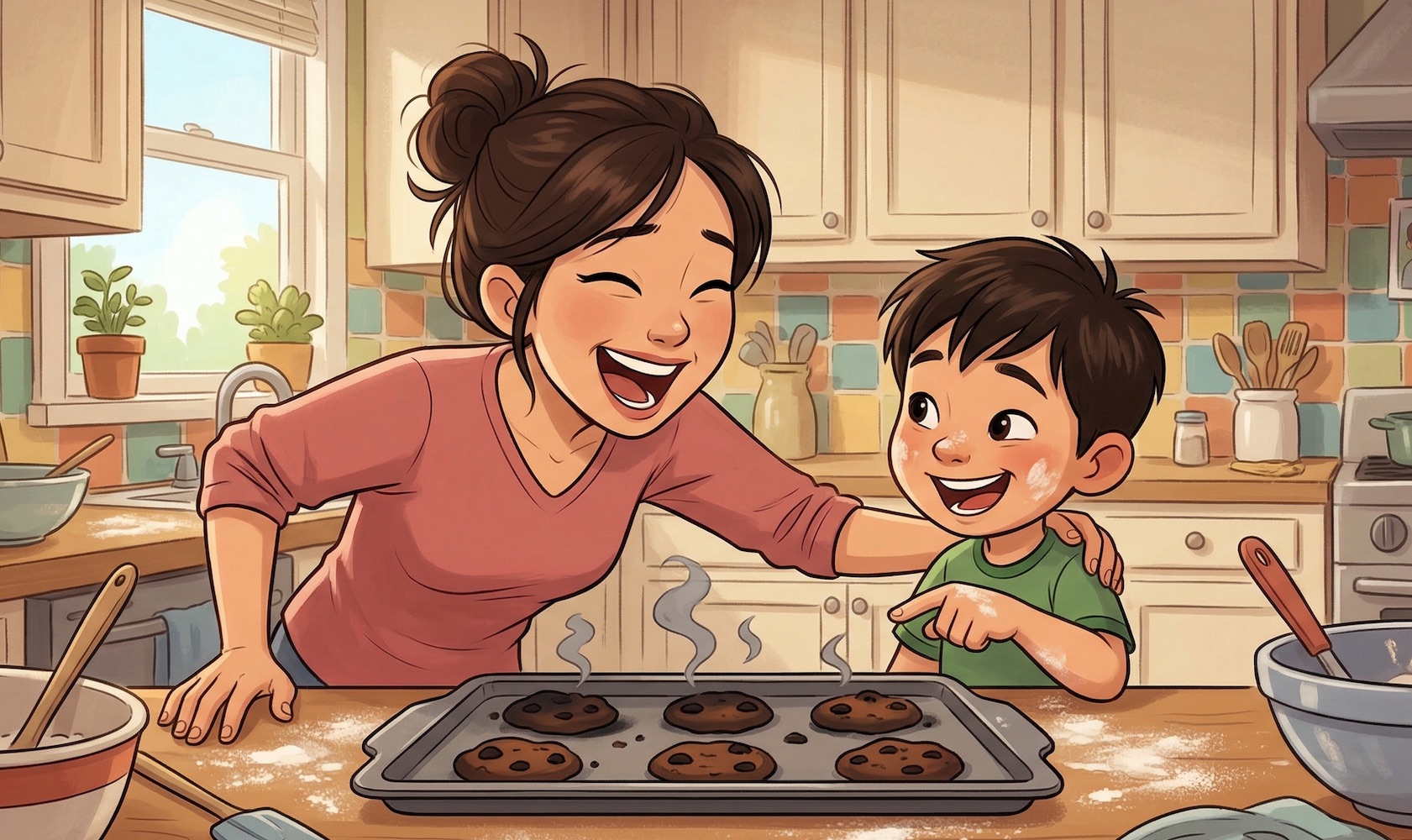
We talk a lot about success, but we rarely talk about the "ugly" start. Show them your own mistakes. Last week, I tried to bake a pandan cake and it came out looking like a green brick. I made sure my kids saw it. I laughed at it. I ate a piece and told them it tasted like rubber but was still fun to make. When they see that you can "look bad" and still be okay, the stakes for their own activities start to drop.
3. The Void Deck Trial
Everything is scarier when there are spectators. Before the official class, take the equipment to the void deck or the local pavement near your block. Kick the ball around where no one is watching. The sun was setting over East Coast Park, the kites were tangling in the breeze, my daughter was crying because her knee was scraped, and I was trying to figure out how to fold the three-wheeled scooter while holding a melting ice cream cone in my left hand. We were a mess. But because we were alone, she tried again. Privacy is the best medicine for a perfectionist child.
4. Watch Your Own Reaction to Your Mistakes
Our kids are like little sponges for our own stress. If you get frustrated when you miss a turn while driving or if you huff when you drop a glass in the kitchen, they learn that mistakes are things to be ashamed of. Try to stay calm when things go wrong for you. Use "low-probability" words to describe your feelings, like saying you feel "skittish" or "clumsy," rather than "angry." It gives them a vocabulary for their own big feelings.
5. Change the Praise
Stop praising the goal. Praise the "try." Instead of saying "You were so good at swimming today," try "I loved how you put your big toe in the water even though you were nervous." This shifts the value from the result to the effort. It makes the "looking bad" part irrelevant because the "looking bad" is where the bravery lives. The courage. The grit. The real growth.
The mirror you didn't know you were holding
The ride up the lift to the fourth-floor tuition centre can feel like a journey to the gallows for a child who is afraid to fail. But remember, your child is looking at you to see how they should feel about themselves. If you are anxious for them to succeed, they will be anxious about failing. They don't need a coach right now; they just need a safe place to land. Relax your shoulders. Soften your gaze. They will get there in their own time, and it probably won't be on the first try. And that is perfectly fine. When was the last time you let them see you fail at something new?