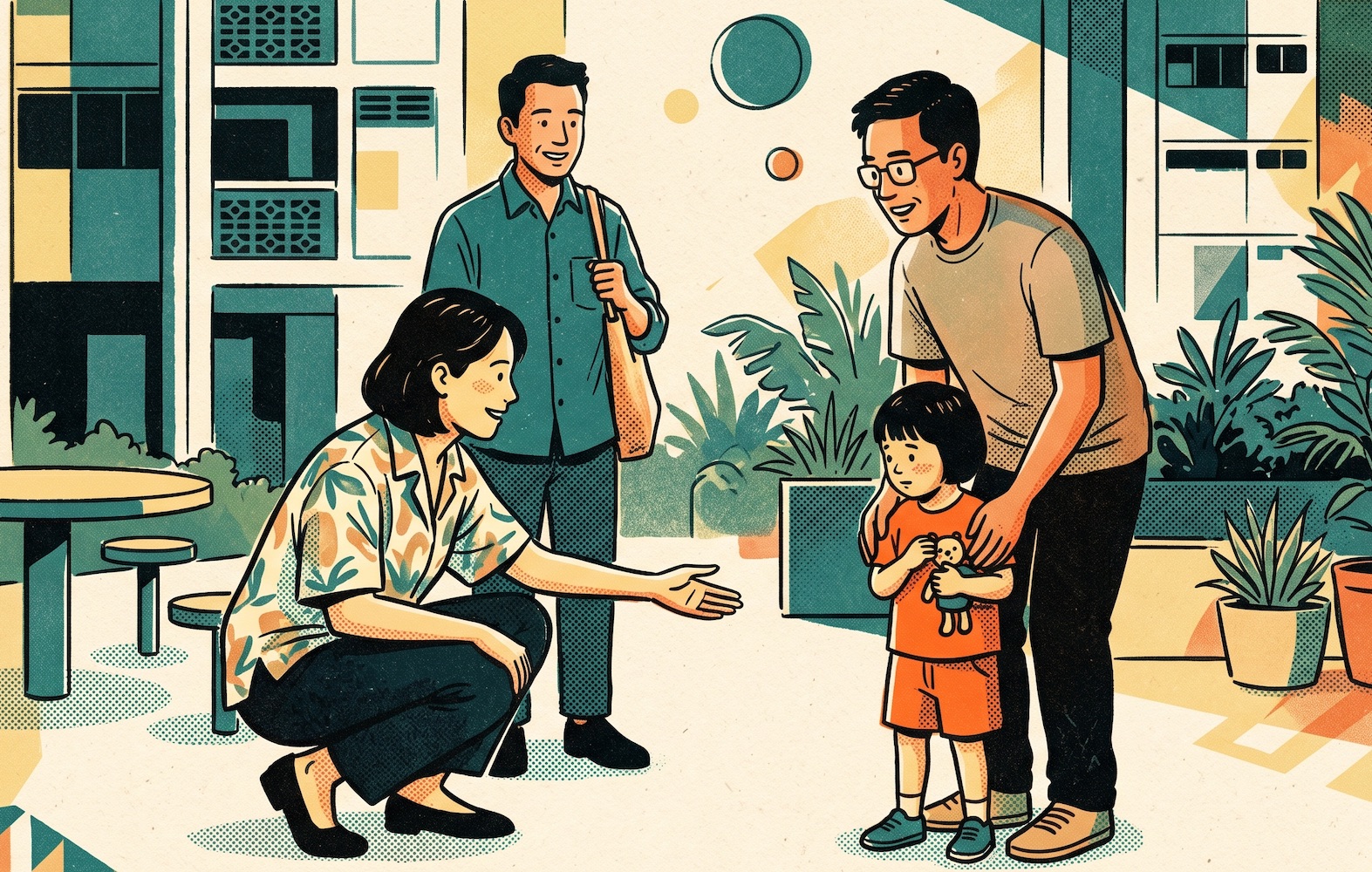
Move beyond "Stranger Danger." Teach your child the "Check First" rule and other essential safety strategies for navigating the world with confidence.
In a safe city like Singapore, it is easy to become complacent. However, teaching children how to interact with people they do not know—moving beyond the outdated "stranger danger" to the more effective "Check First" rule—is a vital life skill. These rules provide a framework for children to explore the world confidently while maintaining clear boundaries for their personal safety.
The "Check First" Foundations: The Top 5 Core Anchor Rules
Safety is about habit, not fear. These five "anchors" are the non-negotiables that every child should know by heart to ensure they never find themselves in a vulnerable position without a parent's knowledge.
#1: The "Check First" Rule ✋
Before you go anywhere, change plans, or get into a vehicle with anyone—even someone you know—you must "Check First" with the parent or guardian in charge of you at that moment.
#2: No Treats from New People 🚫🍬
Never accept sweets, toys, or gifts from someone you do not know well without checking with a parent first. If a stranger offers you something, the answer is always "I need to ask my mum/dad first."
#3: Adults Don't Ask Kids for Help 🙅♂
If a stranger asks you for directions, to help find a lost puppy, or to carry something to their car, walk away. Adults should ask other adults for help, not children.
#4: Identify "Safe Strangers" 👮♂
If you are lost or scared, look for a "Safe Stranger." These are people in uniforms (police, security, mall staff) or a mother with children.
#5: Trust Your "Uh-Oh" Feeling 🚩
If someone makes you feel uncomfortable, weird, or "icky," you have the right to get away from them immediately. You do not need to be "polite" if you feel unsafe.
Communication & Boundaries
Knowing how to talk—and when not to talk—is key to maintaining safety. These rules focus on physical distance and the types of information that should never be shared.
#6: Maintain the Safety Gap 📏
If a stranger approaches you to talk, keep a distance of at least two arm-lengths. If they move closer, you move back.
#7: No Personal Info 🤐
Never tell a stranger your full name, where you live, what school you go to, or your phone number.
#8: The "No Secrets" Rule 🤫
If an adult tells you to keep a "special secret" from your parents, tell your parents immediately. Safe adults do not ask children to keep secrets.
#9: Never Go Behind Closed Doors 🚪
Never enter a stranger's house, a back room of a shop, or a car for any reason, even if they say your parents sent them.
Safety in Public Places
Whether at the park or the shopping centre, children need to know how to handle interactions in the "real world." These rules provide practical steps for public safety.
#10: Use the "Buddy System" 👫
Always go to the public toilet or a different part of the playground with a friend or a sibling. There is safety in numbers.
#11: Don't Approach Cars 🚗
If a car pulls up beside you to ask a question, stay far away from the door. You can shout the answer from a distance or just keep walking.
#12: No Playing in Isolated Areas 🌳
Stay where there are other people around. Avoid stairwells, empty car parks, or thick bushes where you cannot be seen by your parents.
#13: Know Your Parent's Number 📞
Memorise at least one parent's mobile number. If you get lost, a "Safe Stranger" can help you call home.
Emergency Responses
If a situation becomes dangerous, a child needs a clear plan of action. These rules teach the "Yell, Run, Tell" method to help them escape and get help.
#14: Yell, Run, Tell 🗣
If someone tries to grab you or take you away, YELL as loud as you can ("You're not my dad!"), RUN to a safe place, and TELL a safe adult immediately.
#15: It's Okay to be Loud 📢
In an emergency, forget about being "polite" or "quiet." Make as much noise as possible to attract attention from everyone nearby.
#16: Kick, Scream, and Bite 🥋
If someone physically tries to move you, use all your strength to fight back. Do whatever it takes to get away.
Online & Digital Strangers
In the modern world, "strangers" can also be digital. These rules apply the same safety principles to the online games and apps your child uses.
#17: No Online "Friends" 💻
People you meet in online games are still strangers. Never share your photo, your real name, or your location with someone you haven't met in real life.
#18: Report Weird Messages 📩
If someone online asks you to do something weird or says something that makes you feel "uh-oh," show the message to a parent right away.
Final Safety Thoughts
A few final reminders to ensure your child remains aware and empowered without becoming overly fearful of the world.
#19: Use the Family "Code Word" 🔑
Have a secret family code word. If someone says your parents sent them, they MUST know the code word. If they don't, you don't go.
#20: Keep Talking to Us ❤
The most important rule is that you can tell your parents anything. We will never be angry with you for telling us if someone made you feel unsafe.
Master Every Situation
Setting boundaries doesn't stop here. From hawker centres to screen time, explore our full collection of situational rules designed for Singaporean families.
See All Family Rules & Routines