
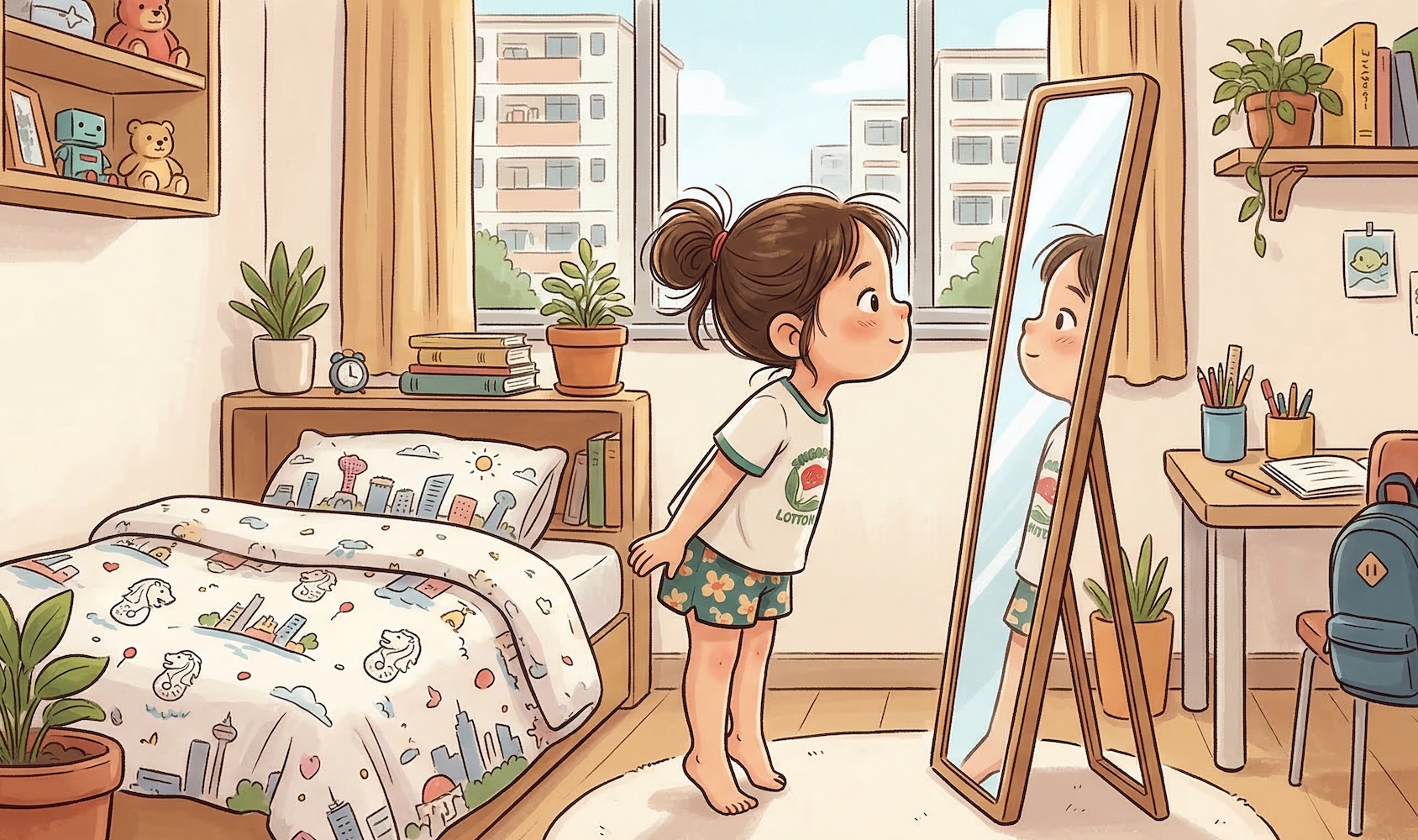
It hits you like a physical blow to the stomach. You are sitting at the dinner table at home, and your little one looks in a mirror and sighs about their tummy. My heart truly goes out to you. When my own daughter, barely into primary school, once pulled at her shirt and asked if she looked "big", I felt a wave of sheer panic. You want to wrap them in a blanket of absolute love and shield them from every harsh word the world might ever throw at them. It is deeply unsettling to hear such heavy, adult worries coming from such small, innocent voices.
Where do these heavy words actually come from?
The playground is a loud, chaotic melting pot of ideas. I remember overhearings at the Punggol Park climbing frame where one child told another they couldn't run fast because of their "big legs". It was blunt and stinging. Children are like little sponges, soaking up every stray comment from a cartoon, a YouTube Short, or even a well-meaning aunty at a family gathering who mentions someone has "put on weight" since the last Chinese New Year. They do not have the filters we do to understand that "fat" is often used as a weapon rather than a descriptor. Sometimes, they are simply trying on new words to see how they feel, much like they try on our oversized shoes.
There is also the subtle mirror of our own habits. Think about the last time you pinched your waist while getting ready for a wedding or complained about your "food baby" after a heavy prata breakfast. They see the frowns we direct at ourselves. They notice when we skip a meal or talk about "good" and "bad" foods. To a child, if the person they love most in the world finds their own body lacking, then bodies must be things that need constant checking and fixing. It is a terrifying realisation. The internalised pressure to look a certain way starts much earlier than we ever want to admit.
Can we look at their "imperfections" differently?
We often rush to say, "No, you're beautiful!" but that only confirms that looks are the most important thing about them. What if we shifted the focus entirely? Instead of seeing a "problem" to be solved with compliments, see a child who is trying to understand how they fit into the physical world. Their body is not an ornament to be admired; it is an incredible tool that allows them to splash in the puddles at the Singapore Botanic Gardens or carry a heavy school bag. When they complain about their looks, they are often expressing a deeper vulnerability or a need for reassurance that they are safe and accepted exactly as they are.
How can we change the conversation at home?

1. Celebrate what the body does
Shift the praise away from the mirror. When my son finishes a long swimming lesson at the complex, I don't talk about how he looks in his trunks; I talk about how strong his arms are for pulling him through the water. We talk about how our legs are amazing for walking all the way from the bus stop to the library. Focus on function. The joy of movement. The power of a heart that pumps blood while we sprint. It makes the body feel like a teammate rather than an enemy.
2. The "All Foods Fit" philosophy
Stop labelling food as "naughty" or "junk". In our house, we have "always" foods like broccoli and fish, and "sometimes" foods like those colourful iced gems or a sweet treat from the bakery. If we treat chocolate like a forbidden fruit, we create a cycle of shame when they eventually eat it. Neutralise the plate. Food is fuel, and sometimes, food is just for the soul and the celebration of a Friday afternoon. It removes the moral weight from the meal.
3. Curate the digital environment
The tablet is a window to a very filtered world. Even "innocent" kid influencers often project a standard of perfection that is completely unattainable and frankly, fake. Check the settings. Block the channels that focus on "glow-ups" or "toy hauls" that equate beauty with happiness. I noticed a huge change in my daughter's mood when we swapped out a certain high-fashion doll cartoon for nature documentaries. Reality is much kinder to the soul than a pixelated version of perfection.
4. Audit your own "Fat Talk"
This is the hardest part. We must stop the self-deprecating comments in front of them. The "I'm too old for this" or "I look like a mess" comments leak into their consciousness. If you need to go on a health kick, frame it as "getting more energy to play catch" rather than "trying to fit into these jeans". Show them that you respect your own vessel. It is a quiet, daily rebellion against a world that wants us to feel small. And honestly? It helps us heal too.
5. Validate the feeling, not the "fact"
When they say "I'm ugly," don't just argue. Ask them, "That sounds like a really sad feeling to have, did something happen today that made you feel that way?" Often, it isn't about the face in the mirror at all. It might be a tiff with a friend or a hard day at school. Address the heart, and the body image concerns often follow suit and settle down. They need to know their worth is unshakable, regardless of a tummy roll or a messy head of hair.
Is your love conditional on a reflection?
Your child is watching you to see how a person should exist in their own skin. They don't need a perfect parent; they need a parent who is at peace. The next time your little one makes a comment about their weight, take a breath and remember that they are looking for a safe harbour in a world that is already trying to change them. When you look at your child tonight while they are sleeping, ignore the height or the weight or the features. Look at the life inside them. Next time they criticize themselves, ask yourself: "Am I reacting with my own insecurities, or am I listening to theirs?"