
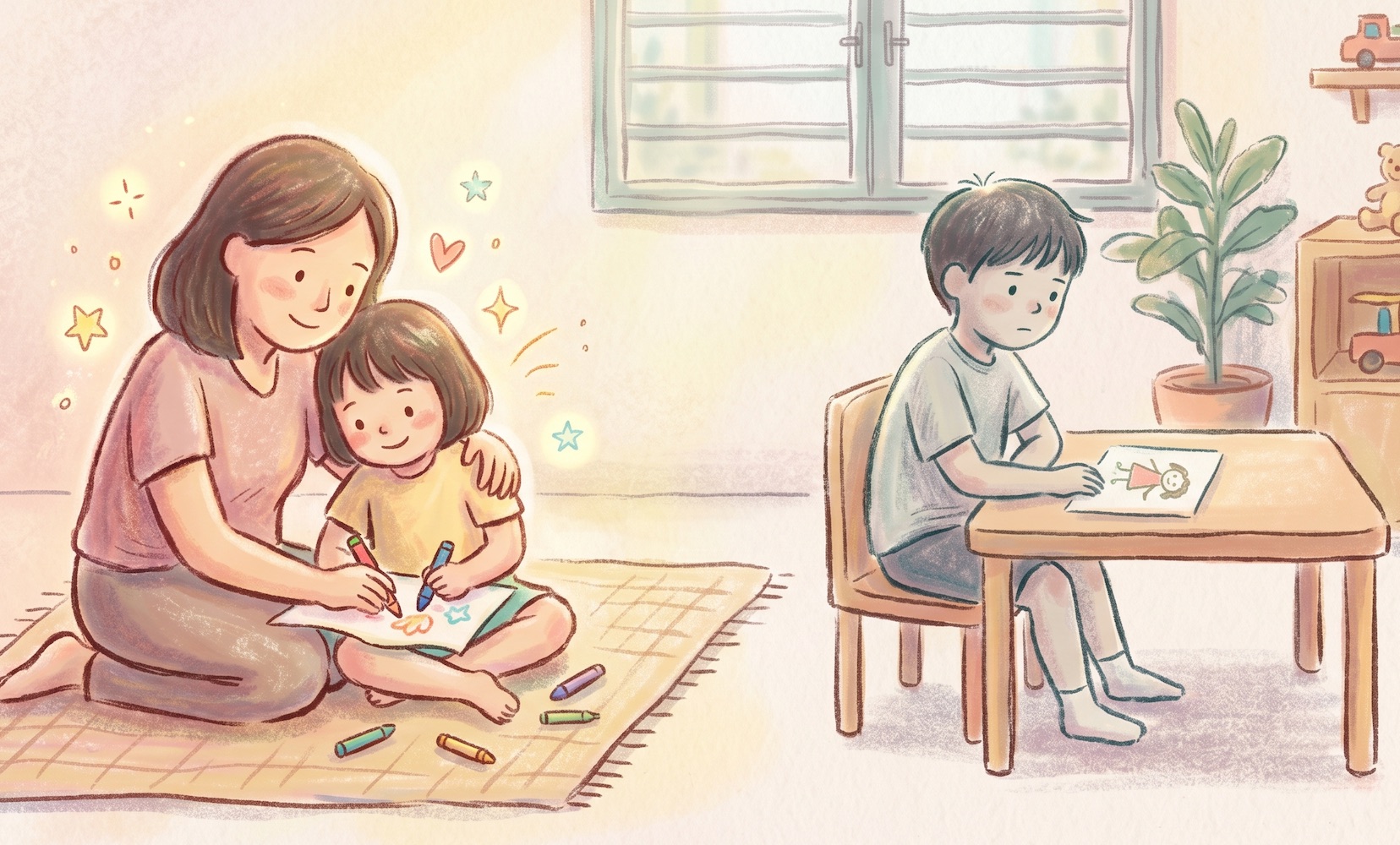
Dear Editor, I'm writing this because I feel like a monster. I have two boys, aged seven and three. My youngest is a breeze—sweet, cuddly, and always listens. But my eldest... he's been difficult since day one. He's stubborn, frequently throws tantrums over schoolwork, and honestly, we clash constantly. I've realised that I actually dread the weekends when he's home all day. I find myself wanting to just play with the younger one and ignoring the older one. I feel so much more natural affection for my toddler, while my eldest feels like a chore. Is it normal to like one child more than the other?
The Heavy Weight of the "Favourite" Child
What you are feeling is one of the last great taboos of parenting, but I can assure you that you are not a "monster." You are a human being navigating a complex relationship. In Singapore, where the pressure to be the "perfect" parent is immense, admitting that you don't feel an equal spark with every child feels like a failure. But here is the truth: love is a commitment, while "liking" is often about temperament and chemistry. Sometimes, we simply vibe better with one personality type over another.
To move forward, we have to stop viewing this as a moral failing and start seeing it as a relational misalignment. Your eldest might be mirroring your own stresses, or perhaps his "difficult" traits are the ones you struggle with in yourself. The goal isn't to force a fake feeling of "equal liking," but to ensure that your behaviour remains equitable and that you are actively building a bridge toward him, even when it feels like uphill work.
5 Actionable Steps to Bridge the Gap
1. Implement "Special Time" Rituals
Commit to just 15 minutes a day of "Special Time" with your eldest where he takes the lead. No teaching, no nagging about homework, and no "why did you do that?" during this block. By removing the "correction" aspect of your relationship for a set period, you allow yourself to see his better traits without the cloud of disciplinary stress. This builds "relationship capital" that makes the harder moments easier to handle.
2. Decode the "Difficult" Behaviour
Often, we dislike the child who triggers us. Sit down and write what specifically irks you about your eldest. Does his stubbornness remind you of a relative you dislike? Or perhaps your own perceived weaknesses? When you separate his behaviour from your emotional triggers, you can respond with calm logic rather than visceral frustration. Understanding the "why" behind his defiance—perhaps he feels your withdrawal—can shift your irritation to empathy.
3. Practice the "Five-to-One" Ratio
Research suggests that for every negative interaction (scolding, correcting), you need five positive ones to maintain a healthy bond. Even if you don't "feel" it yet, look for tiny things to praise: "I like how you put your shoes away" or "Thanks for sharing that joke." This isn't about being fake; it's about retraining your brain to scan for his successes rather than just his faults.
4. Delegate the Friction Points
If schoolwork is the main source of your clashing, see if your spouse, a grandparent, or a tutor can take over that specific role for a season. If every interaction you have with him involves a struggle over assessment books, it's no wonder you feel a lack of "like." Removing yourself from the "enforcer" role in high-stress areas can preserve the emotional space needed for bonding.
5. Seek a "Second Opinion" on His Personality
Talk to his teachers or siblings to see how they perceive him. Sometimes we get stuck in a "narrative" about our child (e.g., "he's the naughty one"). Hearing a teacher talk about his kindness to friends or his curiosity in class can help you see a side of him that you might be missing because you're too close to the daily grind at home.
The "What NOT to Do" Checklist
-
Verbal ComparisonsNever ask "Why can't you be more like your brother?" This creates deep-seated resentment between siblings and confirms the child's fear that he is less loved.
-
Visible OvercompensationDon't shower the "favoured" child with more gifts or privileges in front of the other. Children are highly sensitive to "fairness" in resources, even if they can't articulate it.
-
Labelling the ChildrenAvoid calling them "The Easy One" and "The Trouble-maker." These labels become self-fulfilling prophecies that the child will grow to inhabit permanently.
-
Isolating the GuiltDon't keep these feelings bottled up until you explode. Talk to a therapist or a trusted, non-judgemental friend. Guilt usually leads to further withdrawal from the child.
-
Expecting an Instant FixDo not expect to wake up tomorrow feeling "equal" love. Building a relationship with a child who has a different temperament is a marathon, not a sprint.
The Reality Check
Here is the hard truth: You may never "like" your children exactly the same amount at every stage of their lives. Parenting is a dynamic journey. There will be years where your eldest becomes your closest confidant and your youngest becomes the "difficult" teenager. Equity is more important than equality. As long as you are providing him with safety, attention, and the tools to grow—and as long as you are working on your own reactions—you are doing the work of a good parent. Feelings follow action; keep acting with love, and the "like" often finds its way back.
Real-Life Support Resources
-
Located across Singapore, FSCs provide professional counselling for parents struggling with family dynamics and emotional bonding.
-
Offers workshops and resources specifically designed to help parents manage behavioural issues and strengthen parent-child relationships.
-
While focused on family violence, they offer excellent resources on healthy family boundaries and managing high-conflict parent-child dynamics.
-
If the guilt and stress of parenting are leading to feelings of hopelessness or severe mental distress, their 24/7 hotline is available.
-
Provides practical evidence-based parenting advice and one-on-one "Parenting Coaching" sessions for specific relational hurdles.