
It was 9 PM last Tuesday. My daughter finally stopped asking for a third glass of water, and the son was sprawled across his bed like a tiny starfish, finally quiet. I sat on the pavement outside our front door, the humidity pressing against my neck, just breathing. My wife looked at me from the doorway, her eyes reflecting that familiar "we made it" exhaustion. We were efficient co-parents, sure. But as I looked at her, I realised I couldn't remember the last time we talked about something that didn't involve school fees, nap schedules, or whose turn it was to wash the milk bottles. We were drifting into that "roommate" phase, where the love is steady but the spark is buried under a mountain of laundry.

Prioritising date nights is the only way to save a relationship from the "co-parenting colleague" trap, according to recent research. To stop postponing your relationship, couples must use regular, intentional outings to move from "parent mode" back to "partner mode," effectively rebuilding emotional intimacy through shared novelty and restorative connection. I saw this mentioned in a Life.gov.sg guide recently—the one about rediscovering romance after children. It makes sense. If we don't design our time together, the chaos of parenthood will design it for us.
"Do you even remember what we used to talk about before the kids?" she asked, leaning against the doorframe. I laughed, but it felt a bit hollow. "I think it involved movies and where to find the best prata in Bedok," I replied. "Now it's just... logistics."
A strong marriage isn't the result of an easy life, but the outcome of two people choosing to be a couple first, even when the kids are screaming for attention.
"2-2-2" Rule for the Fortnightly Outing
Logic suggests that if you don't maintain a machine, it eventually breaks. Relationships are no different. When we neglect the "us" part of the family, the whole structure feels shaky. It is about building a buffer against the daily mess of life.
The Marriage Foundation actually tracks this, showing that parents of young children—specifically those in the three to five-year-old range—see a significant increase in stability when they keep up a monthly date night. My dad-buddies share the same sentiments. The ones who make time for their wives seem less burnt out. They have a different energy. But the challenge of finding a "sitter" in Singapore (where everyone is always tired) is like trying to find a parking spot at Jewel on a Sunday. It's tough.
So we try using the "2-2-2" rule as a rough guide. A proper date every two weeks, even if it's just a late-night walk to the nearest petrol station for ice cream. No kid-talk allowed. It's a deliberate circuit-breaker.
Novelty as a Relationship Palette Cleanser
As a former designer, I know that visual fatigue is real. You look at the same walls and the same faces every day, and everything blurs. We need a "reset" for our eyes and our brains. New environments trigger something in us that the living room couch simply can't.
Shared novelty wakes up the same dopamine circuits that powered our early romance. I read about this on CNA; it's about moving from "steady warmth" back into excitement. I tried to apply this by taking my wife to a sensory-rich spot, like art jamming with cats. Messy. Loud. Unexpected. It was a far cry from our usual routine of Netflix and silence. It was about seeing her laugh at a smudge of paint on her nose instead of worrying about the next day's meal prep.
We now look for "high-design" experiences that don't cost a fortune. Architectural walks along the Changi Boardwalk offer that "Jeju-island" aesthetic for free. It's about the atmosphere, not the price tag.

Building the Emotional Love Bank - 10-minute nightly check-in
Think of your relationship as a community garden. You can't just plant the seeds and walk away. You have to pull the weeds. You have to water it. Every small interaction is a deposit into a shared account that you'll need to draw from when things get stressful.
There's this concept of "bids for connection" that TOUCH Community Services emphasizes. It's the small stuff—a look, a joke, a shared sigh. If we ignore these bids because we're too busy with the kids, the "Love Bank" goes dry. I've felt that immensely. I've been the dad who's too tired to listen to his wife's story about her day because I just spent ten hours listening to a toddler. It's a mistake. A big one.
Now, we use the "10-minute check-in" every night. No phones. No talk about the kids' school. Just us. It's a micro-ritual that keeps the connection alive without needing a fancy dinner reservation.
The Tactile Connection of Slow Craft
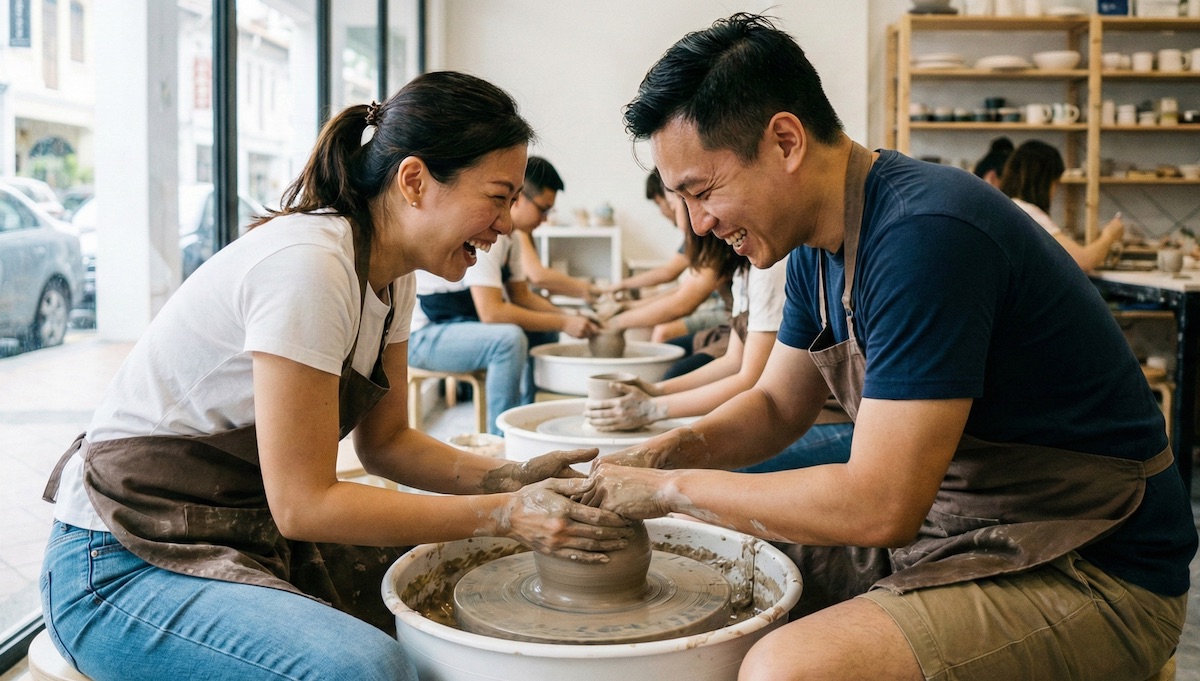
The smell of wet clay. The cool touch of a pottery wheel. The focus required to shape something from nothing. There's something deeply restorative about doing something tactile together. It pulls you out of your head and into the moment.
I found a mention of "slow craft" dates in a Singapore Women's Weekly article. Places like Common Touch Craft Unit offer these three-hour windows where you just... create. For a designer, it's like coming home. For us as a couple, it's a way to bond through shared play. We aren't "negotiating" anything; we're just making something together. It's a physical manifestation of our partnership. The Rain Tree outside the studio window was dripping from a late afternoon shower, and for those few hours, the noise of the city felt miles away.
We started doing small "at-home" craft sessions too. Even just building a complex LEGO set together after the kids are asleep can provide that same sense of shared accomplishment. It's about the process, not the product.

Navigating the Transition from Dad to Partner
Switching gears is the hardest part. You spend all day in "service mode," making sure everyone else is fed and happy. By the time the date starts, you're a shell of a person. You need a bridge to get from there to here.
The MSF Family Assist site suggests using "We" statements to prevent defensiveness, but honestly? It starts with the senses. I need to wash the "dad smell" off—the faint scent of playdough and milk—and put on a clean shirt. It sounds superficial, but it's a psychological reset. If I look like a partner, I start to feel like one. It's a deliberate act of shedding the day's roles.
We use a "transition ritual." On the lift ride down, we agree to leave the "parent" versions of ourselves in the flat. For the next few hours, we are just two people who happen to have kids, rather than two parents who happen to be on a date.
"Let's just be us for a bit," I whispered as the lift hit the ground floor. She squeezed my hand. It feels like younger years again.
Being a parent is a shared journey, but being a couple is the destination we must never stop trying to reach.
TLDR; If you're waiting for a "better time" to focus on your relationship, you're waiting for a ghost that isn't coming. When was the last time you saw your partner as a person, not just a teammate?
Hey hey... If you're looking for a low-cost, high-aesthetic date in the East tonight, go to Changi Bay Point just before sunset. Bring a flask of tea. The silence is better than any five-star meal.
- Life.gov.sg: Marriage Support and Rediscovering Romance
- CNA: The Science of Keeping the Spark Alive
- Marriage Foundation: The Impact of Date Nights on Stability
- TOUCH: Strengthening Marriage Through Parenthood
- Singapore Women's Weekly: Unique Date Ideas
- MSF Family Assist: Tips for Dads on Relationship Changes
- TheSmartLocal: Free Date Ideas in Singapore
- Singapore Motherhood: Date Ideas for Recharging Parents