The Monkey Pot Trap: Knowing When to Release Your Parental Grip

When we cling stubbornly to a rigid vision of who our children should be, we risk destroying our relationship with who they actually are. The traditional parable of the monkey pot trap offers a striking metaphor for the danger of an unyielding grip, reminding us that true parental leadership requires knowing when to release our grasp to preserve what truly matters.

PerspectiveNon-AttachmentAgilityEmotional PreservationUnconditional Acceptance

The Monkey Pot Trap: The Danger of an Unyielding Grip

In various traditional farming communities bordering the jungle, trackers have used a deceptively simple yet flawless method for capturing wild monkeys without using cages, nets, or weapons. They rely entirely on a specialized tool known as a monkey pot trap.

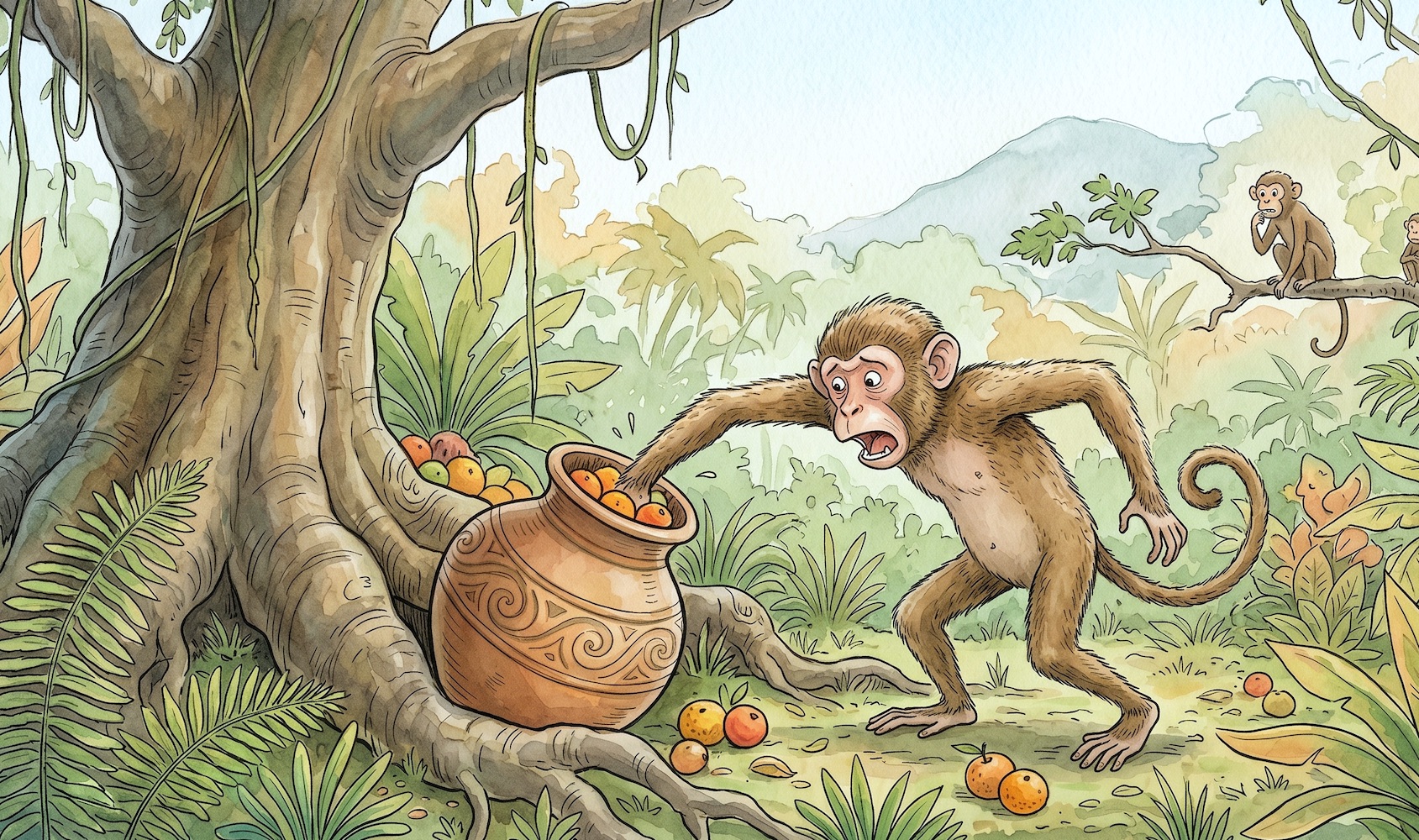
The trap consists of a heavy, thick-walled clay jar or a hollowed-out gourd secured firmly to the base of a large tree trunk. The defining feature of this vessel is its exceptionally narrow neck—the opening is just wide enough for an inquisitive monkey to slide its open, flat hand inside, but completely unyielding if that hand is balled into a fist.

Inside the jar, the trackers place a highly enticing piece of bait—usually a sweet piece of ripe fruit, a handful of fragrant nuts, or a bright, shiny object. Attracted by the scent, a monkey will swing down from the canopy, spot the treasure, and slide its open hand through the narrow neck to grasp the prize. It wraps its fingers tightly around the fruit, forming a solid fist.

However, when the monkey attempts to pull its hand out, it hits a hard ceiling. The fist is now too wide to clear the narrow opening. The solution to its freedom is incredibly simple: all the monkey needs to do is open its fingers, release the fruit, and slide its hand back out. It is completely free to walk away at any second. But the monkey refuses to let go of the prize. It tugs, screeches, and pulls for hours, trapped entirely by its own unwavering grip, until the trackers quietly return to make the capture. The monkey is not held captive by the jar; it is held captive by its own refusal to release what it wants.

Bringing the Story Home

Use these notes to translate the story into a meaningful conversations.

Lesson behind the Tale

Letting go is not an act of defeat; it is an act of preservation. As parents, our deep love for our children often morphs into a fierce, white-knuckled grip on specific outcomes—such as specific grades, elite school choices, or idealised career paths.

When our children struggle or display different inclinations, we can turn into the trapped monkey, squeezing our expectations tighter out of sheer panic. We fail to realise that our refusal to adapt is precisely what is trapping our family in conflict. Sometimes, releasing your grip on a specific expectation is the only way to save the child standing in front of you.

Relating to Our World

In Singapore's tightly structured social matrix, "The Monkey Pot" is a highly relatable systemic reality. The sweet fruit inside our container is clearly defined: a spot in an Integrated Programme (IP) school, an ideal university scholarship, or a prestigious corporate trajectory. Because our society has historically rewarded these specific prizes, we as parents can form an aggressive, uncompromising fist around them. We convince ourselves that keeping our grip tight is the only way to secure our child's future safety.

But when a child displays acute anxiety, a distinct learning profile, or a profound passion for an unconventional path, our rigid fist becomes a structural hazard. By forcing a child to squeeze through an opening that doesn't fit their natural configuration, we induce immense psychological friction. The constant friction manifests as domestic breakdown, depression, or teenage rebellion. True parental stewardship requires the agility to evaluate the landscape objectively. We must ask ourselves whether the prize inside the jar is worth the emotional capture of our child's spirit.

Opening the Dialogue

"What specific 'prize' or idealized timeline are you currently gripping so tightly in your child's life that it is creating constant friction in your home?"

  • If you are gripping academic benchmarks, stream placements, or specific school paths Acknowledge that your grip may be driven by a fear of societal judgment or historical definitions of success. Look closely at your child's mental wellness. If the cost of chasing that specific benchmark is their emotional baseline, it is time to open your hand. Explore alternative pathways, tertiary options, or modular successes that allow them to grow without breaking.
  • If you are gripping behavioral perfection or an unyielding standard of compliance Understand that character development is a winding path, not a linear assembly line. If you treat every developmental misstep or phase of resistance as a catastrophic failure, you will alienate your child. Loosen your grip on the day-to-day minutiae so you can preserve your strategic influence for the core values that truly matter.

"If you were to completely open your hand and release that single expectation today, what are you terrified would happen next?"

  • If you fear they will fail, give up, or 'fall behind' in Singapore Recognise that children rarely collapse when an artificial expectation is removed; instead, they finally gain the room to breathe and find their own footing. When you stop managing their journey out of anxiety, they are forced to take personal ownership of their path. Your trust becomes the catalyst for their self-reliance.
  • If you fear you will look like an irresponsible or permissive parent Separate your ego from your child's immediate choices. True parental maturity means choosing the long-term psychological health of your child over the short-term approval of relatives, neighbours, or peer groups. Your primary duty is to be your child's sanctuary, not a reflection of external expectations.

Putting it into Practice

Identify the number one source of recurring verbal arguments or tension between you and your child right now (e.g., math revision, room tidiness, or a specific hobby). For the next seven days, execute a deliberate mental release on this specific issue. Lower the stakes entirely. If they miss a revision session, do not lecture. If their layout is untidy, close the door. Redirect all the energy you normally spend on tracking and forcing compliance into building a low-stakes, positive connection.

Take them out for a meal, watch a show together, or chat about a topic they care about without any underlying agenda. Observe how quickly their defensiveness drops when they realise you have stopped pulling on the trap.

Build Character, One Story at a Time

Nurturing values like integrity and courage doesn't happen overnight. Explore our full library of stories designed to help parents navigate every milestone.

Browse More Stories About Life

Recommend for You