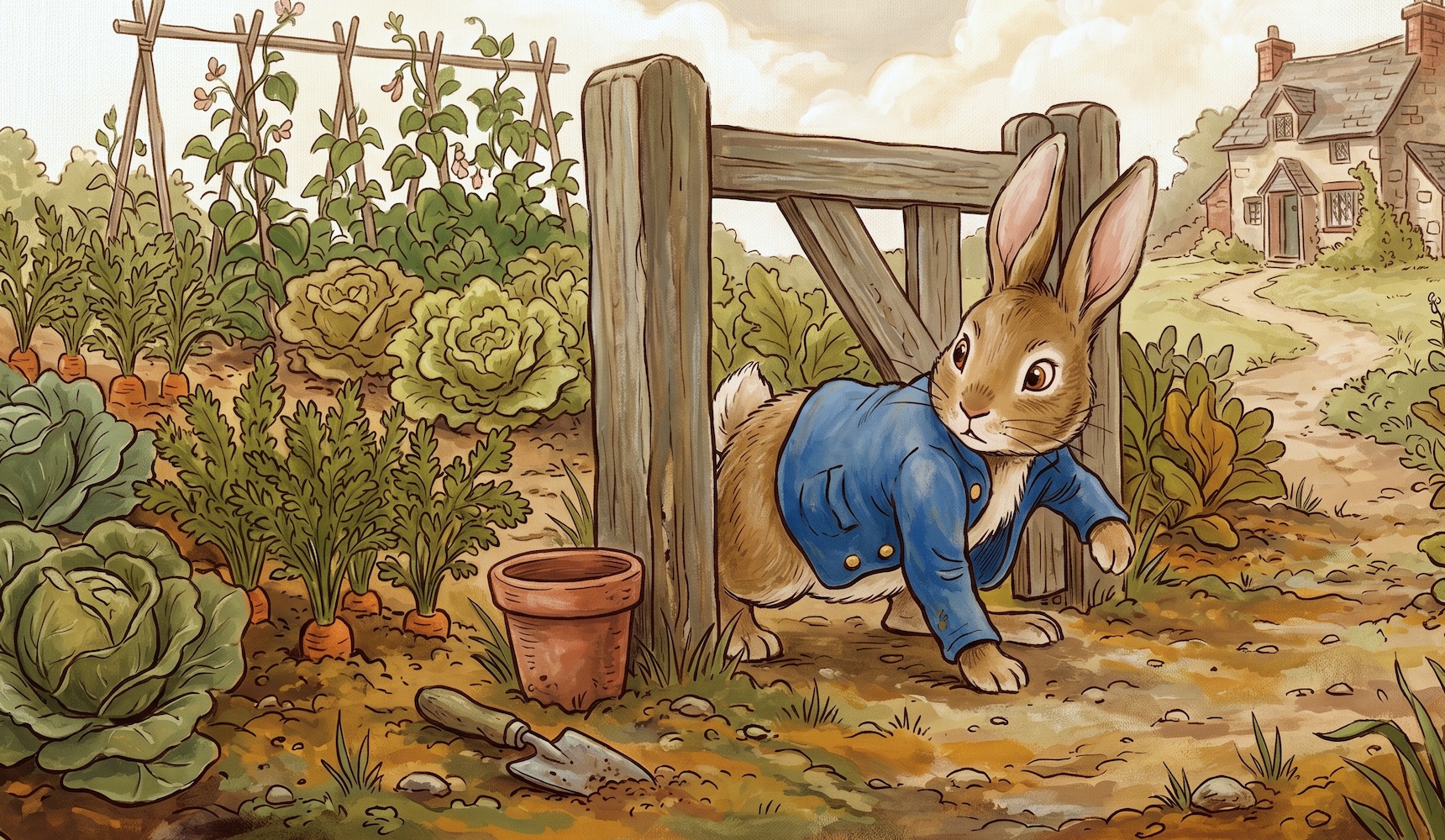
The Tale of Peter Rabbit: Personal Responsibility and Natural Outcomes

Beyond the blue jacket and the garden gate lies a profound lesson in the weight of our choices. The Tale of Peter Rabbit serves as a timeless entry point for older children to discuss the difference between "getting caught" and the inherent stress of crossing boundaries. It reframes obedience not as a lack of freedom, but as a necessary guardrail for safety and peace of mind.

Personal ResponsibilitySelf-DisciplineConsequences

The Tale of Peter Rabbit

Four young rabbits—Flopsy, Mopsy, Cottontail, and Peter—lived with their mother under the root of a massive fir tree. One morning, their mother gave them a clear warning: "You may go into the fields or down the lane, but do not go into Mr. McGregor's garden. Your father had a terrible accident there."

While his sisters spent the morning safely gathering blackberries along the lane, Peter decided the rules didn't apply to him. He squeezed under Mr. McGregor's gate and headed straight for the vegetables. He gorged himself on lettuce, French beans, and radishes. But the moment he finished eating, the "fun" stopped. He felt sick, and even worse—he felt watched.

Suddenly, around a cucumber frame, he came face-to-face with Mr. McGregor. The chase was on. Peter panicked. In his rush to escape, he lost his shoes in the dirt. He ran so fast he might have made it out, but he ran headfirst into a gooseberry net. The large brass buttons on his brand-new blue jacket got snagged in the mesh. He was trapped.

Peter broke down in tears, certain he was finished. But a few sparrows chirped at him, urging him to keep moving. Just as Mr. McGregor arrived with a heavy sieve to trap him, Peter wriggled free, leaving his jacket behind. He hid in a watering can in the tool shed—cold, wet, and trembling with fear.

By the time Peter finally found the gate and slipped back to the woods, he was exhausted. He collapsed on the floor of the rabbit-hole. His mother, busy cooking, noticed he had returned without his shoes or his jacket—the second outfit he had lost in just two weeks.

That night, Peter didn't get to join the feast. While Flopsy, Mopsy, and Cottontail enjoyed a delicious supper of bread, milk, and blackberries, Peter was sent straight to bed with a bitter dose of camomile tea. He had his "freedom" in the garden, but he lost his clothes, his dinner, and his peace of mind to get it.

Bringing the Story Home

Use these notes to translate the story into a meaningful conversations.

Lesson behind the Tale

Boundaries aren't fences to stop your fun; they are guardrails to protect your peace. When we break a rule, the true cost isn't just getting caught—it's the stress of the chase and the loss of trust (your "blue jacket"). True independence is earned by showing you can manage the garden without needing a gate.

Relating to Our World

In Singapore, kids often live under a high degree of supervision. As they hit the 8-12 age range, they start to crave "secret" independence—sneaking extra screen time, going to places they shouldn't, or skipping homework. Like Peter, they often focus on not getting caught rather than why the rule is there.

We can use this story to explain that as they grow, we want to give them more "garden space," but that freedom depends on their ability to manage themselves. Every time they "lose a jacket" by breaking trust, it takes a little longer to get the next one.

Opening the Dialogue

"Peter spent the whole time in the garden looking over his shoulder. Even while he was eating the 'stolen' carrots, he was trembling. Have you ever snuck something—like extra game time or a snack—but found you couldn't actually enjoy it because you were too busy listening for footsteps?"

  • If they admit to the stress "That's the 'Peter Rabbit' trap. The fun of the garden disappears the moment the stress of hiding starts. True freedom is being able to relax because you aren't hiding anything."
  • If they say 'I wasn't stressed' "Maybe not at first. But Peter felt fine until he lost his shoes and his jacket. Breaking a boundary is like a gamble—you might win the carrot, but are you prepared to lose the 'jacket' (your trust or your privileges) to get it?"

"Peter lost his new blue jacket—the second one in two weeks. Do you think his mom was more upset about the money spent on the clothes, or the fact that she couldn't trust him to stay safe anymore?"

  • If they say 'The money/clothes' "Clothes can be replaced, but trust is harder. Because he kept 'losing his jacket,' his mom knew he wasn't ready for bigger responsibilities. When we set rules, it's often because we're waiting for you to prove you can handle more garden space safely."
  • If they say 'The trust' "Spot on. Every time Peter broke a rule, he stayed a 'little bunny' in his mom's eyes. If he wanted to be treated like a grown-up rabbit, he had to show he could manage himself without a fence."

Putting it into Practice

Sit down and look at one rule in the house that your child finds "annoying." Ask them to explain why they think that rule exists. If they can show they understand the safety or responsibility behind it, offer a "Trust Promotion"—a small increase in freedom (like 15 more minutes of autonomy) to show that following the path keeps the garden gate open.

Build Character, One Story at a Time

Nurturing values like integrity and courage doesn't happen overnight. Explore our full library of stories designed to help parents navigate every milestone.

Browse More Stories About Life

Recommend for You