
Best Toys for 6-9 Year Olds
-
Part 1: Choosing the Best Toys for 6-9 Year Olds
— How to choose toys to suit their learning and developmental milestones -
Part 2: 20 Best Toys for 6-9 Year Olds
— Top 20 toys for exploring technical mastery, logic, and nature stewardship
Choosing the best toys for 6 - 9 year olds requires selecting open-ended tools that foster cognitive agency and social cooperation. Focus on items that encourage "tinkering," problem-solving, and nature-based exploration to support emotional regulation and developmental mastery during this critical life stage.
"Mama, if I plant the Lego flower in the real soil, will it grow plastic petals?" my seven-year-old asked yesterday. I didn't laugh; I just saw her trying to bridge two worlds.
"Play is the work of the child, and for the middle-years learner, that work is about building an internal world that can withstand the noise of the external one."
Choose toys that develop cognitive agency

At this age, children stop just "playing" and start testing how things break and mend. They want to know the "why" behind the "how," and their toys need to reflect that appetite for logic. If a toy only does one thing, it's a dead end. My eldest recently spent three hours with a pile of cardboard and some old string, trying to build a "pulley system" for her dolls. It was messy, it was frustrating, and it was exactly what she needed.
The UNICEF research on learning through play highlights that play for this age group is iterative. They use materials to revise hypotheses and discover new challenges. This resonates deeply with our life, though I'll admit, keeping a "tinkering station" in a small flat feels like a constant battle against the tide of clutter. It sounds good on paper to have "loose parts," but when you trip over a gear at 2 AM, the philosophy feels a bit thin.
My fix is the "One Box Rule." All "work-in-progress" projects stay in one specific wooden crate. If it doesn't fit, we photograph the creation to "save" the memory, and then we take it apart to make room for the next idea. This keeps the space clear while honouring her need to build.
Choose toys that ground the nervous system
The buzz of school, the bright lights of the shopping mall, and the constant digital hum can leave a primary-schooler feeling frazzled. I've noticed my daughter's mood shifts after she's spent an hour with clay or water—something tactile and "slow." It's not just a hobby; it's a way for her to find her centre again after a long day of following rules and sitting at a desk.
The Mayo Clinic notes that nature immersion for as little as 20 minutes can significantly lower anxiety and improve cognitive resiliency. In our urban setting, we don't always have a forest, so we bring the forest in. We choose toys made of sustainable timber or cork, and we spend time with our "urban farm"—a few pots of basil and mint on the ledge. It's about biophilia, the innate love for living things.
But this isn't just about "buying" nature toys. It's about the interaction. We use a simple magnifying glass to look at the veins in a leaf we found on the pavement near the lift lobby. That $5 glass is a better "toy" than any $100 electronic tablet because it connects her to the real world. Simple. Grounded.

Choose toys that encourage social scaffolding through role-play
The shift from solitary play to complex peer relationships is a massive hurdle. Last Tuesday at the playground, I watched a group of seven-year-olds negotiate the rules of a "tag" game for twenty minutes before they actually started running. The negotiation was the play. Toys that facilitate this—like puppets, costumes, or even simple walkie-talkies—act as social training wheels.
An ECD manual from UNICEF mentions that role-play helps children prepare for real-life social complexities. I see this when my girls use their dolls to act out a fight they had earlier. It's restorative. But implementation is hard when the "trendy" toys at school are all about individual collectables rather than shared stories. The peer pressure is real.
We've started hosting "swap days." Instead of buying new, we invite a friend over to trade toys for a week. This teaches the girls about sharing resources and gives them "new" social tools without adding to the permanent clutter of our home. It's a small way to live out our values of minimalism in a world that always wants more.
The "Grown-up" transition: real tools, not just toys
As our children move deeper into their school years, they begin to seek mastery over their physical environment. They want to see tangible results from their efforts, moving away from simple "pretend" play toward actual utility. Transitioning from "toys" to "real tools" is one of the most restorative shifts you can make. It acknowledges their growing competence and satisfies a deep-seated need for cognitive agency.

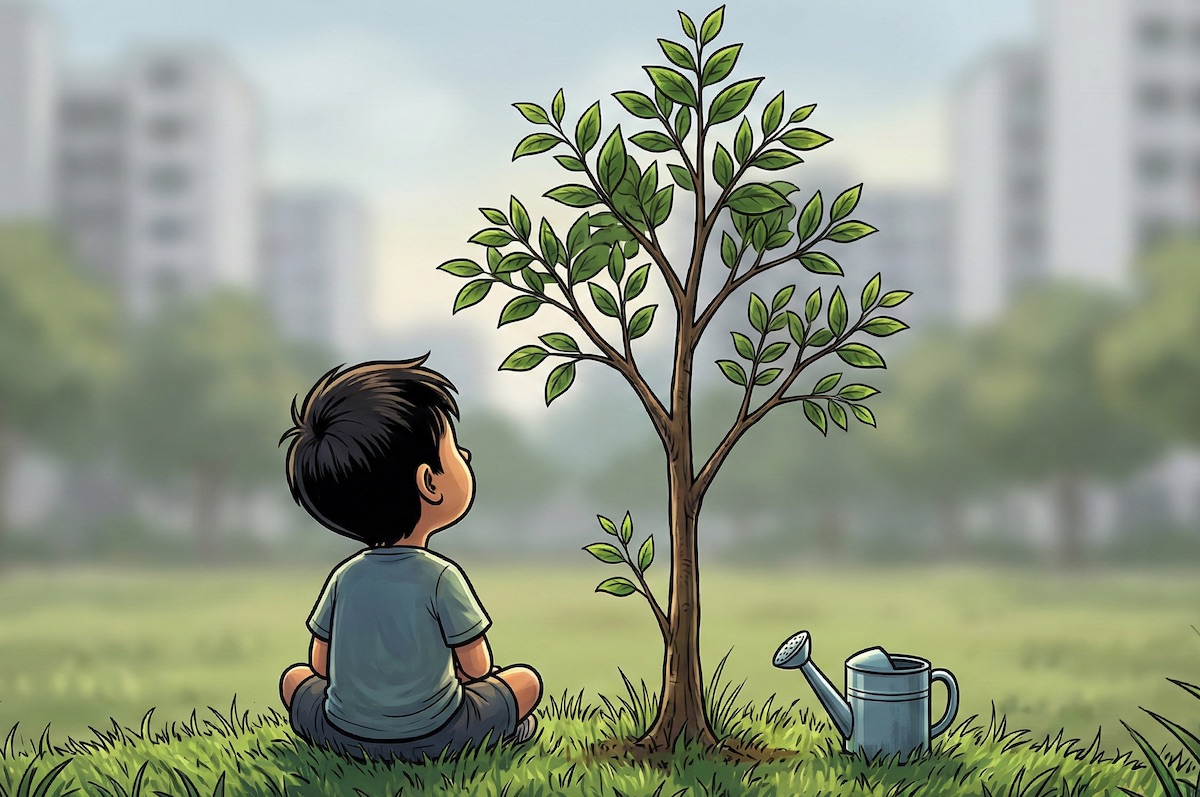
I saw this mentioned in a UNICEF parenting guide—the one about how children at this stage develop self-esteem through the acquisition of actual skills. Instead of a plastic gardening set that snaps under the weight of real Singaporean clay-loam, we invested in a sturdy metal hand trowel and a small, functional watering can. When my eldest helps me in our corridor farm, the look of quiet concentration on her face is worth more than any "educational" game. It marks her shift from being a passive consumer of play to an active participant in life.
My practical fix is to start with "transitional" tools that offer sensory weight but remain safe for HDB living. Think real watercolour sets with heavy-duty paper, a basic sewing kit with blunt-tipped needles, or a functional magnifying glass for the lift lobby's resident ants. These items don't just occupy time; they build a sense of purpose and grounding. And honestly? It works.
Choose toys that embody intentional spending
Before any toy enters our door, we ask: "Does this help you grow, or does it just keep you busy?" This is our deliberate litmus test. I want my daughters to value quality over quantity. If we splurge, it's on something like a high-quality microscope or a sturdy bicycle—things that open up the world rather than closing it down into a screen.
I read an article on Channel News Asia about the importance of intentional spending. It's about helping children distinguish between a fleeting "want" and a deep value. It's a hard lesson to teach when every shopfront in a place like Tampines Mall is screaming for their attention. The friction between my minimalist ideals and their desire to fit in is constant. It's a daily practice of gentle "no" and meaningful "yes."
"But everyone has one, Mama!" she said, pointing at a plastic mystery box. I knelt down. We talked about how the box only gives a surprise for a minute, but the seeds we bought for the garden give us a surprise every morning when we check for sprouts. She didn't entirely agree, but she put the box back. Progress.
Choose nature playgardens as the ultimate toy
In Singapore, we are lucky to have spaces designed for this exact age group. The NParks design guidelines explain how nature playgardens use logs, boulders, and sand to create "affordances"—opportunities for play that aren't scripted. These are the best toys money can't buy. They challenge my eldest's motor skills and settle her mind in a way no plastic climbing frame ever could.

I've seen this play out at the park. She spent an hour trying to balance a long branch across two rocks to make a "bridge." No manual. No batteries. Just physics and focus. It's beautiful to watch. The dirt under her fingernails is a sign of a morning well spent.
"Minimalism isn't about having nothing; it's about making room for the things that truly nourish the spirit—a handful of soil, a sturdy tool, and the time to see what happens next."
The Bottom Line
If we treat our children's play as a quiet sanctuary rather than a noisy marketplace, what kind of adults will they become? Are we giving them toys to escape the world, or tools to understand it better?
If you're looking for a place to start, head to a local nursery this weekend. Buy a small pot, some soil, and a packet of seeds. Let that be the "toy" for the week. Watch the magic happen.
How about next time you're at the neighbourhood hardware shop, skip the toy aisle. Buy a real spirit level or a small tape measure. Watch how their play changes when the "work" becomes real.