
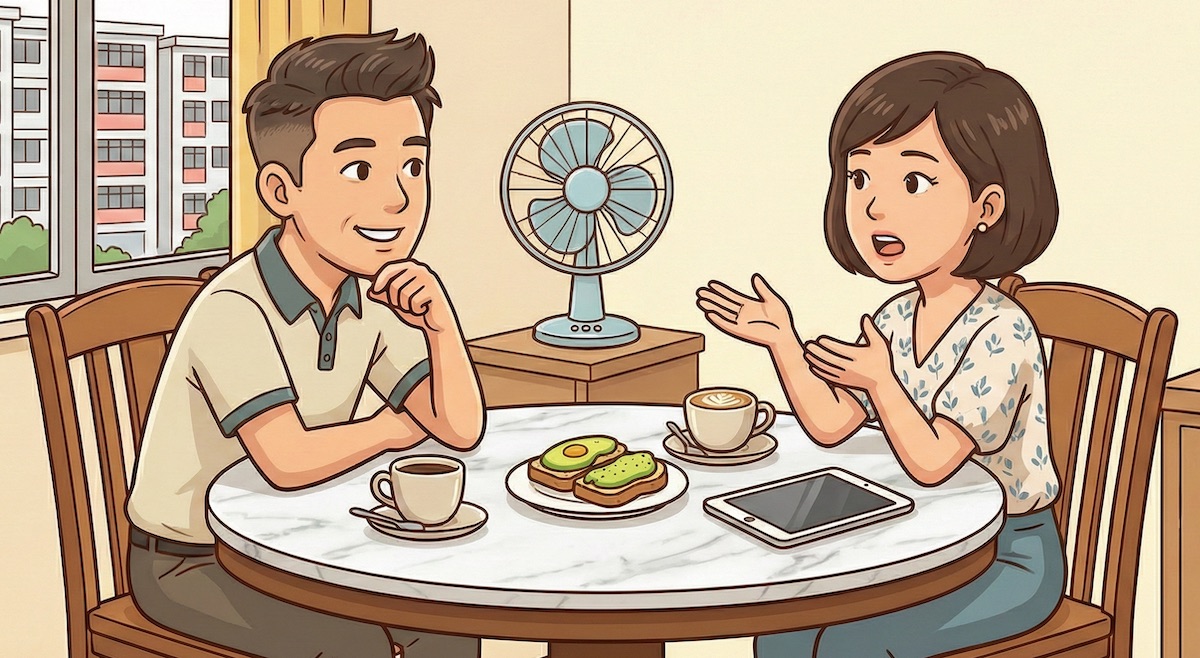
Resolving parenting conflicts requires couples to adopt an authoritative approach that balances high emotional warmth with clear, consistent boundaries. By prioritising the child's sense of security over being "right", parents create a stable environment for development.
Peace in the home is not the absence of conflict, but the presence of a safe way to resolve it.
The humidity was thick enough to wear as a coat as I stood by the kitchen counter last night, watching my son try to explain why his sister's Lego tower "needed" to be demolished. My husband and I locked eyes. I saw the familiar flash of frustration in his face—the same look that usually leads to a debate about discipline versus "letting them be kids". It is in these quiet, sticky moments that the weight of our legacy really hits me.

"He needs a proper timeout, or he'll never learn respect," my husband whispered, his voice tight. I took a breath, feeling that familiar tug in my chest. "I think he's just overwhelmed by the school day," I replied softly, "maybe we just sit with him first?"
Building a unified front through shared values
When my husband and I disagree on how to handle a tantrum at the playground downstairs, the rift feels wider than it actually is. We both want the same thing: a kind, well-adjusted child. Logic dictates that if we aren't aligned, our children will sense the gap and feel untethered. It is about the long-term emotional blueprint we are handing them.
The UNICEF research highlights that providing "identical messages" is a cornerstone of healthy development. When one of us undermines the other, our daughter's eyes dart between us, searching for where the real authority lies. It creates a friction that makes everyone irritable.
It's not actually about having the same rules for everything—it's about the big stuff. So we hold a "Parenting Huddle" every Sunday night. We don't talk about bills or work. We just talk about the kids. If my son is struggling with sharing, we agree on the one phrase we will both use. It sounds simple. It is remarkably hard to do when you're tired.
Protecting the child's internal world - talking about it "later"
Children are like little radars. They pick up on the micro-clenches of a jaw or the way a parent sighs when they walk into a room. My five-year-old knows when something is "off" before I even open my mouth. Their emotional safety depends on our ability to keep our adult disagreements away from their direct line of sight.

UNICEF notes that children take emotional cues from us to feel safe. My friends' share with me that their kids sometimes mimicking their own stressed-out arguments. That was a wake-up call for me. If I'm snappy, they're snappy.
Our rule is "Take it to the Lift Lobby". If a discussion starts getting heated, one of us will simply say, "Let's talk about this later." It isn't about avoiding the issue. It's about containing the fire. We save the heavy lifting for when the kids are asleep and the house is finally, mercifully quiet.
The authoritative middle path can be okay too
The Mayo Clinic points toward an authoritative style as the gold standard. The challenge comes when your son has just spilled Ribena all over the cream sofa, "warm responsiveness" is the last thing on your mind. My instinct is to shout; my husband's instinct is to go silent. Neither helps.
We've had to learn to meet in the middle. I've realised that my husband's desire for order isn't "mean", and my desire for empathy isn't "soft". By blending them, we give our children a structure that actually feels like a hug. It's about being firm on the spilled drink but gentle on the child who spilled it.
When things go wrong, I count to ten. I look at the sky outside the window and remind myself that this mess is temporary. Then, I ask my husband, "What's the goal here?" It usually resets our brains from "combat mode" to "co-parent mode".
Active listening as a bridge
A HealthHub SG guide mentions that treating children with respect involves active listening. The same applies to my partner. If I'm just waiting for my turn to speak, I'm not listening. I'm just reloading.

I saw this in a HealthHub article the other day—the one about bonding. It argued that criticism shuts down communication. When I tell my husband he's being too strict, he stops sharing his perspective. We lose the chance to solve the problem together. The friction is real, especially when we've both had long days at the office and just want the kids to go to bed.
"I feel worried when we use that tone," instead of "You always shout." It's a tiny shift, but the energy in the room changes. It feels less like an attack and more like an invitation.
Breaking the cycle of reactivity
I remember a Today Online commentary where a father talked about picking up the slack to save his marriage. It reminded me that parenting isn't a 50/50 split. Some days it's 80/20. Some days it's 10/90. If we are constantly tallying scores, the children are the ones who lose.
The adjustment we made was acknowledging the "Exhaustion Gap". If one of us is at a breaking point, the other steps in without being asked. No questions. No resentment. Just a hand on the shoulder and a "I've got this, go have a shower." It stops the conflict before it even begins. And honestly? It works for our family.
We are teaching them how to love by how we treat each other when things get difficult.
Bottom Line: If your children see you disagree, let them also see you make up; the repair is far more important than the rupture. Next time you're about to snap over a parenting choice, ask yourself if you'll even remember this specific disagreement in three years. Usually, the answer is no.
- MSF: Parallel Co-Parenting Styles
- MSF: Cooperative Co-Parenting Benefits
- HealthHub: Resolving Conflicts with Respect
- Today Online: Breaking Conflict Cycles
- UNICEF: Emotional Cues and Conflict
- WHO: Impact of Harsh Parenting
- UNICEF: Harmonization of Parenting Styles
- CNA: Relational Negotiation in Parenting
- Mayo Clinic: Authoritative Parenting Ground