
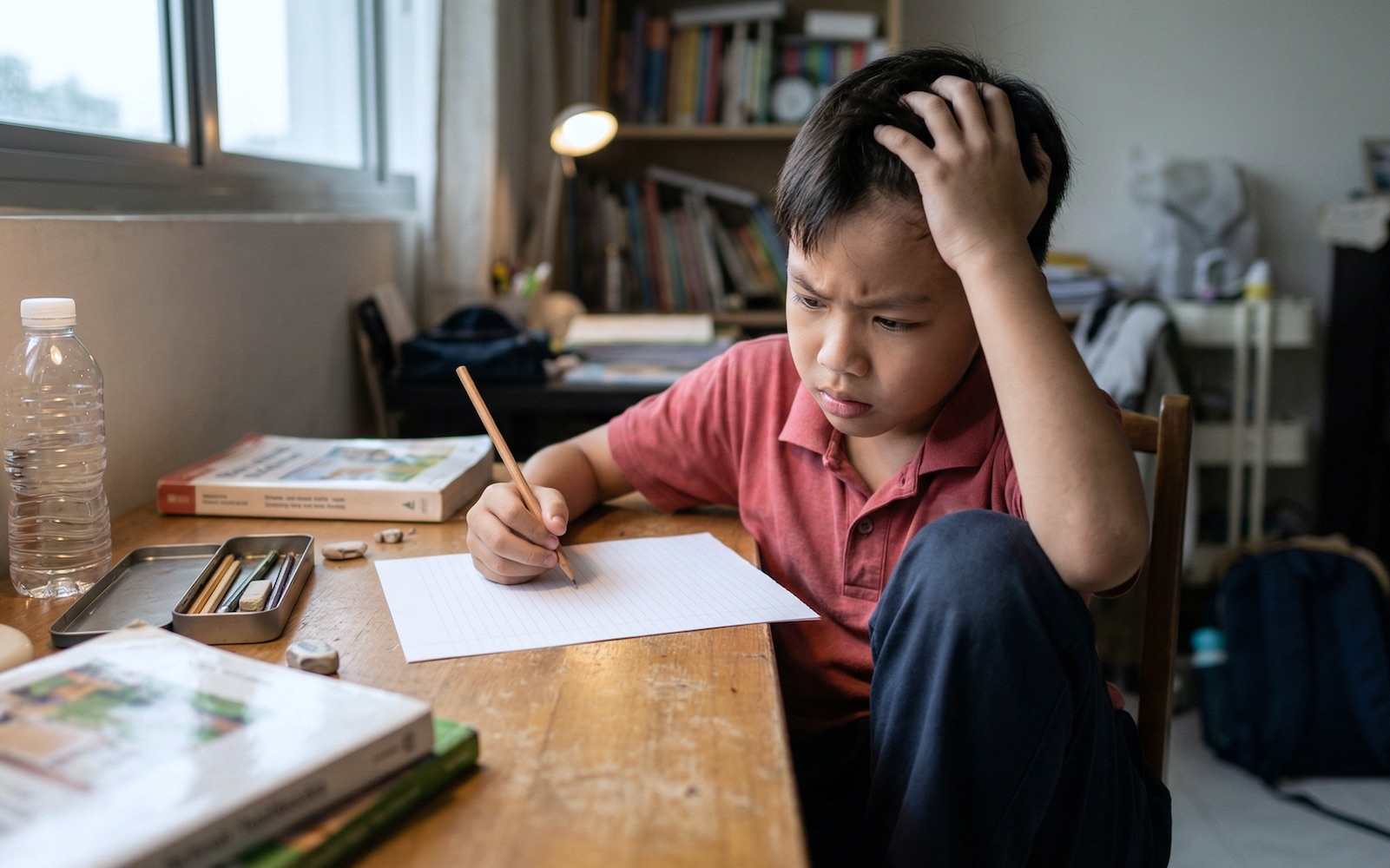
This usually happens right after you have cleared the dinner plates and set out the foolscap paper, hoping for a productive hour before bedtime. You see your child staring at those blue lines as if they are bars on a cage, their grip on the pencil tightening until their knuckles turn white, yet not a single word appears. Or how your child simply burst into tears the moment he reads the prompt about "A Brave Act." He didn't want to be brave; he just wanted to hide. If you are sitting across from a blank page tonight, please take a deep breath. You are not failing, and neither is your child. We just need to find where the words went.
Why does the ink stop flowing?
The smell of pencil shavings and the sharp, rhythmic clicking of a ballpoint pen usually signal work is happening, but sometimes the quiet is too loud. Often, what we see as a "shutdown" is actually a very common freeze response. When a child looks at a composition prompt and feels they don't have the "right" vocabulary or the "perfect" opening, their brain treats that blank page like a threat. It's the "Am I good enough?" fear. Primary school can feel like a high-stakes race where every word is judged, and for some, the fear of making a mistake is much bigger than the desire to tell a story. This isn't laziness. It's a internal traffic jam of ideas and anxiety.
Another reason? Cognitive overload. Think about everything we ask them to do at once. They have to come up with a plot, remember their spelling, use "show-not-tell" phrases they learned in enrichment class, and keep their handwriting neat. It's like asking someone to juggle flaming torches while reciting the national anthem. Sometimes, the brain just decides to turn off the lights to save energy. I noticed this with my seven-year-old; if he's had a long day at school, his "word bank" basically goes on strike.
The hidden message in a blank page
I used to think my daughter was just being difficult when she refused to finish her drawings, leaving half-done figures scattered across the floor. Then I realised the silence wasn't a "no" to the task, but a "help" for her feelings. When your child shuts down, they aren't trying to annoy you or waste time. They are stuck in a moment where their internal critic is louder than their imagination. If we see this as a lack of skill, we get frustrated. If we see it as a lack of safety, we can become the person who helps them build a bridge back to their thoughts. The goal isn't a finished story; it's a child who feels safe enough to be messy.
Try to see that blank page as a mirror of their current state. Are they tired? Are they hungry? Or is the ghost of a strict marking rubric hovering over their shoulder? When we change our view from "my child won't write" to "my child is overwhelmed," the tension in the room usually drops. We stop being the supervisor and start being the secretary. That shift changes everything about how the evening goes.

Small steps to find their voice
1. Try the "Oral First" Rule
Put the pencil down. Leave the paper on the dining table and go for a walk to the nearest park or even just down to the void deck for some fresh air. Ask them to tell you the story as if it's a movie they just watched. No grammar checks, no "better words" suggestions—just the plot. When the pressure to write is gone, the ideas usually come tumbling out. Once they've said it aloud, the paper feels much less scary.
2. The "Ugly" First Draft
Tell them the first draft is allowed to be "rubbish." I tell my son that his first try should be as messy as a kitchen after baking. Use a pencil, use Singlish if they must, and ignore the spelling for ten minutes. The point is to get the "bones" of the story down. You can always go back and fix the spelling later, but you can't fix a page that has nothing on it. Permission to be imperfect is a huge relief for a perfectionist child.
3. Use Photo Prompts Instead
Words are abstract, but pictures are concrete. If the school prompt is too dry, find a funny photo on your phone or a magazine. Ask them, "What happened one minute before this photo was taken?" This builds the muscle of imagination without the heavy weight of a formal "Composition Topic." It's like a warm-up at the gym. You wouldn't lift a heavy barbell without stretching first, right?
4. The 10-Minute Dash
Set a timer for just ten minutes. Tell them they only have to write for that long, and then they can take a break to play with their Lego or have a snack. Long, indefinite stretches of time feel like a prison sentence to a child who is struggling. A short burst feels doable. I've found that often, once the ten minutes are up, they've found their rhythm and actually want to keep going. The start is always the hardest part.
5. Build a "Comfort" Word Bank
Keep a small notebook of words they actually like, not just "chim" words from a textbook. Maybe they love the word "shimmer" or "clattered." When they are stuck, give them three of their favourite words and challenge them to fit them into the story. It turns a chore into a bit of a puzzle. It makes the language theirs again, rather than something they are borrowing from a teacher's whiteboard.
The weight of the first word
Whether it's the pressure of the upcoming exams or just a simple classroom spelling test, our little ones often carry a heavy load of expectations that we might not even realise we are piling onto their small, slumped shoulders as we rush from school to tuition. It's heavy. We need to remember that their worth isn't found in a Grade A composition or a perfectly structured climax. Sometimes, the most "creative" thing a child can do is tell you they are scared to try.